Commercial to Residential in 2026, When Irish Investors Reassess Duplex and Small Block Strategies
Commercial Property · By David S · 18 September 2026
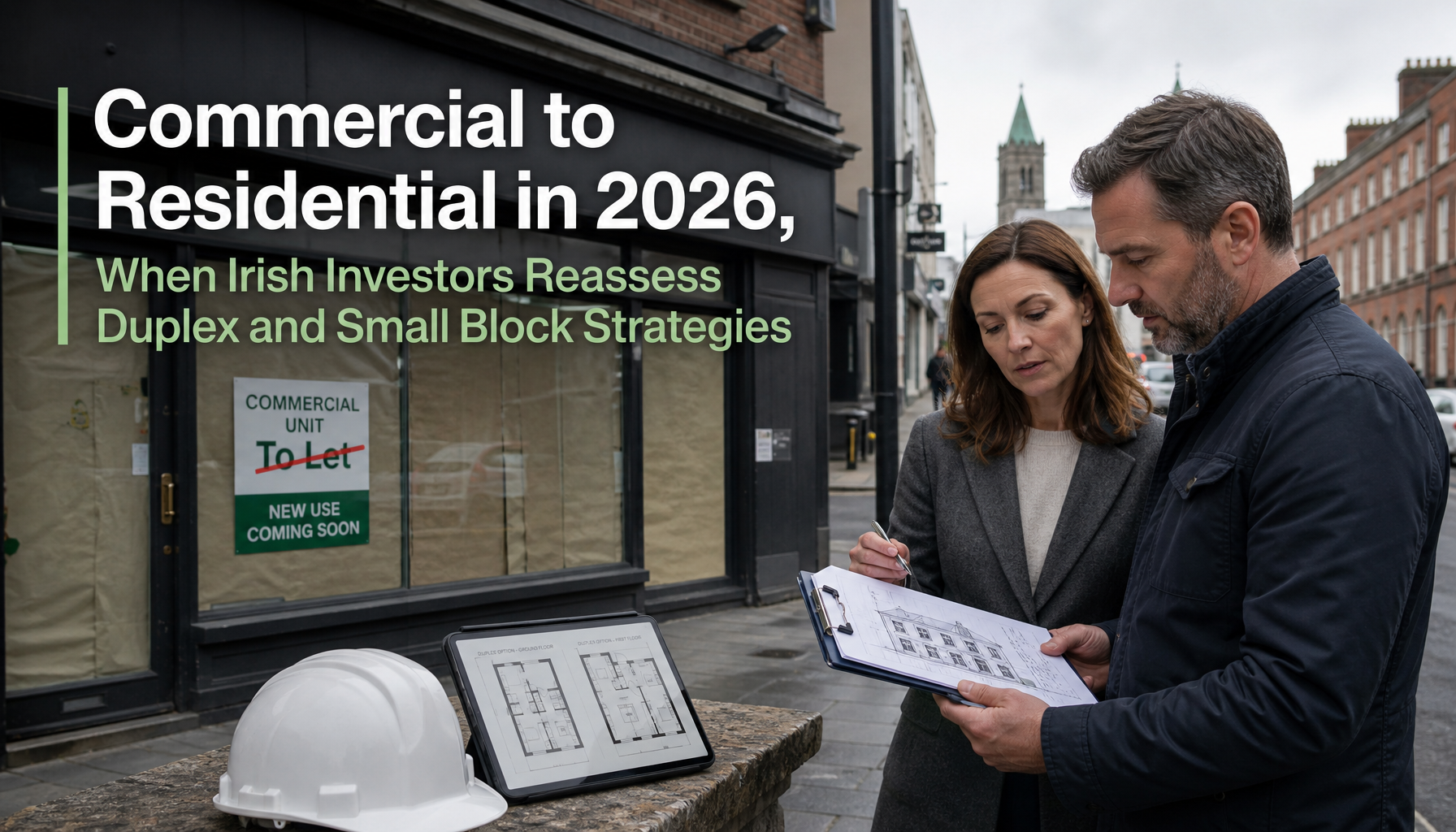
In 2026, the phrase Irish property trends 2026 small blocks duplex is showing up more often in investor conversations, particularly among those who build, buy, or refurbish small multi-unit properties. Alongside that interest is another shift: a growing willingness to reassess older commercial stock and consider a commercial to residential route where feasible. For some, it is a way to align with what renters and owner-occupiers are actually looking for. For others, it is a response to uncertainty in pricing, leasing risk, and letting demand in certain locations.
This explainer is not about a single magic strategy. Instead, it maps out why the duplex and small block approach is being re-examined, what conversion decisions tend to hinge on, and how investors can think through the trade-offs without assuming that every site will behave the same way. For context on the wider economic backdrop, it is also worth keeping an eye on updates from the RTE Business news and the Central Bank of Ireland as conditions and guidance can influence sentiment across property and lending.
Why duplex and small block strategies are back in focus in 2026
Duplexes and small blocks can appeal to Irish investors because they sit between two extremes. On one side are single units that can be easier to understand, manage, and finance. On the other side are larger developments that demand more capital, longer timelines, and higher execution risk. A duplex or a two to four unit block often looks like a practical compromise, especially when an investor aims to create separate tenancies for a buy-to-let strategy or to sell individual units later, depending on the plan.
In 2026, though, interest is not only about size. It is also about match. Investors are increasingly asking whether their chosen format still suits the rental and lifestyle expectations that Irish households have developed. The strongest demand tends to cluster around practical layouts, good energy performance, and straightforward day-to-day living. When those factors are built into the plan from the start, duplex and small block projects can be more resilient than assets that require heavy reworking after purchase.
That brings us to the second half of the equation. If you buy an older commercial premises, you may already be carrying the wrong asset design for today’s residents. The question becomes: can it be turned into housing in a way that is credible, costed correctly, and sale or letting-ready?
The conversion question, what investors are really weighing
A move from commercial to residential is not automatically a positive development in 2026. It is simply another option on the menu, and the menu is getting more carefully scrutinised. Investors tend to reassess conversions in three broad areas: feasibility, market fit, and total risk.
Feasibility, the hidden driver of outcomes
Many conversion plans falter because the feasibility work happens too late. In practical terms, investors often need to understand early whether a given building can be divided into habitable, lettable units that meet modern expectations. That can include:
- Layout constraints, such as where services can run and how natural light will land inside each unit.
- Access and separation, especially for multi-unit buildings where common areas and private boundaries affect tenant satisfaction and management.
- Energy and comfort, since buyers and renters increasingly expect homes that feel efficient to run and stable to live in.
- Works sequencing, so construction staging does not balloon programme risk.
It also helps to compare the conversion path to alternative acquisition routes. Sometimes, buying a property already designed for residential use can reduce uncertainty even if the purchase price is higher. Other times, conversion offers value that would not exist in the open market for standard residential stock.
Market fit, duplex and small blocks still need the right demand
Even a well-executed conversion can underperform if the end product does not match local demand. This is where investors increasingly look beyond headline locations and into the micro-level reality: tenant preferences, transport patterns, and what similar units are actually letting or selling for nearby. If you are considering a multi-unit investment Ireland approach, pay attention to whether the area is likely to absorb duplex-style living or whether other formats are preferred.
RightPlace guides that focus on where demand is shifting can be useful for investors and house hunters alike. For example, this type of planning sits alongside content like RightPlace Research: What Irish Renters Actually Want in 2026 (and where demand is shifting.
Total risk, programme, permissions, and contingency costs
One reason commercial-to-residential ideas are being re-assessed in 2026 is that conversions can change hands with a bigger price tag of uncertainty. Programme slippage, cost increases, or requirements discovered during works can all matter. Investors are increasingly building contingency into their thinking, not as a last-minute response but as part of early appraisal.
Professional guidance is particularly important here. Even if you have a solid development background, it can be wise to get specialist input on compliance, design constraints, and timelines before you decide whether a site fits your risk tolerance. In ambiguous cases, treat early estimates as directional rather than guaranteed outcomes.
How the buy-to-let strategy lens changes with conversions
For investors running a buy-to-let strategy, the conversion decision is usually about improving rental resilience. The idea is simple: a better designed unit tends to rent more reliably, and a tenant who is satisfied is less likely to leave quickly. However, the pathway matters. A conversion that creates a high-spec finish but creates ongoing management complexity can be a mixed result.
When assessing a small block approach, investors often consider:
- Letting velocity expectations, meaning how quickly units are likely to find tenants after completion.
- Ongoing management demands, including shared services and maintenance responsibilities.
- Tenant experience, which can be affected by entry systems, waste arrangements, and parking access.
If you are also planning to market individual units rather than hold long-term, think about whether the product profile aligns with buyers and renters in that specific market segment. In other words, is it more attractive as a family-style rental, a professional let, or a low-maintenance lifestyle option?
What Irish investors can do in 2026 before they commit
Whether the aim is a duplex build, a small block conversion, or a hybrid plan, the best outcomes in 2026 tend to come from structured preparation. Here are practical steps many investors are leaning on.
1. Run a unit-by-unit viability view
Instead of thinking of the project as a whole, model it as multiple units with separate letting or sale outcomes. A single awkward unit can affect the entire risk profile if it takes longer to let or requires extra work to become market-ready.
2. Compare against residential acquisition alternatives
Sometimes the opportunity is real, but sometimes it is not. Investors can compare conversion value to buying a ready-to-go residential asset and refurbishing lightly. That is not always the cheaper option, but it can be the lower uncertainty option depending on the site.
3. Plan the marketing story early
In small multi-unit projects, your marketing narrative should connect to what households want. If the project can deliver features that are meaningful to renters, it should be presented clearly at listing stage. If you are thinking about what to rent out and where, it can help to view relevant stock and understand how similar units are described and priced on /property-to-rent.
4. Use realistic pricing and offer strategies
If you are selling individual units, pricing approach becomes part of execution. In 2026, many sellers find that rigid pricing can limit the number of serious offers. A pricing strategy that stays within clear bands can draw a wider set of bidders. For a broader explanation of pricing mechanics, see Selling in 2026 Without Overpricing: How to Use Pricing Bands to Attract Offers.
5. Get the landlord administration picture right, if holding long-term
Conversion ideas often assume that building and finishing are the hard parts. In reality, management and administration can be equally time-consuming. If you are planning a multi-unit investment Ireland model, consider the practical documentation and ongoing obligations that come with tenancies. Where relevant, landlords also benefit from structured planning, such as the checklist approach in Landlord Admin in 2026, The Document Checklist for Tenancies (Start to End).
Commercial to residential in 2026, a strategy, not a shortcut
The shift in 2026 is less about converting because it is fashionable, and more about converting because it might be the best way to create something that fits current housing expectations. Investors reassessing duplex and small block strategies are effectively asking: can we reduce uncertainty, improve unit quality, and create a clearer demand match?
That is why you will see some portfolios tilt away from purely commercial income and towards housing-linked outcomes, whether via long-term rental hold or staged sales. But conversions should be judged on project-specific facts, not on assumptions about the market generally moving in the same direction.
If you are exploring sites, start by narrowing to properties where the basic conversion logic makes sense, then build your plan around unit usability, cost realism, and the on-the-ground demand in that neighbourhood. And if you are not sure about your assumptions, speak with appropriate professionals before you lock into a timeline.
Where to look next on RightPlace.ie
If you want to benchmark what is available right now, it is useful to compare across categories. Many investors cross-check what is for sale, what is for rent, and what is currently being marketed as residential-ready. Start with:
- /property-for-sale to scan duplex and small block options, and see what similar properties are asking for.
- /property-to-rent to understand which unit types appear easiest to let in your target area.
- /commercial if you are specifically looking at candidate premises that could potentially be redeveloped.
For investors and owner-occupiers alike, 2026 is a year of more careful decision-making. Duplexes and small blocks remain relevant, but the best projects are the ones where strategy meets practicality, and where commercial-to-residential ideas are validated with evidence early enough to matter.