Selling in 2026 Without Overpricing: How to Use Pricing Bands to Attract Offers
Selling · By David S · 3 September 2026
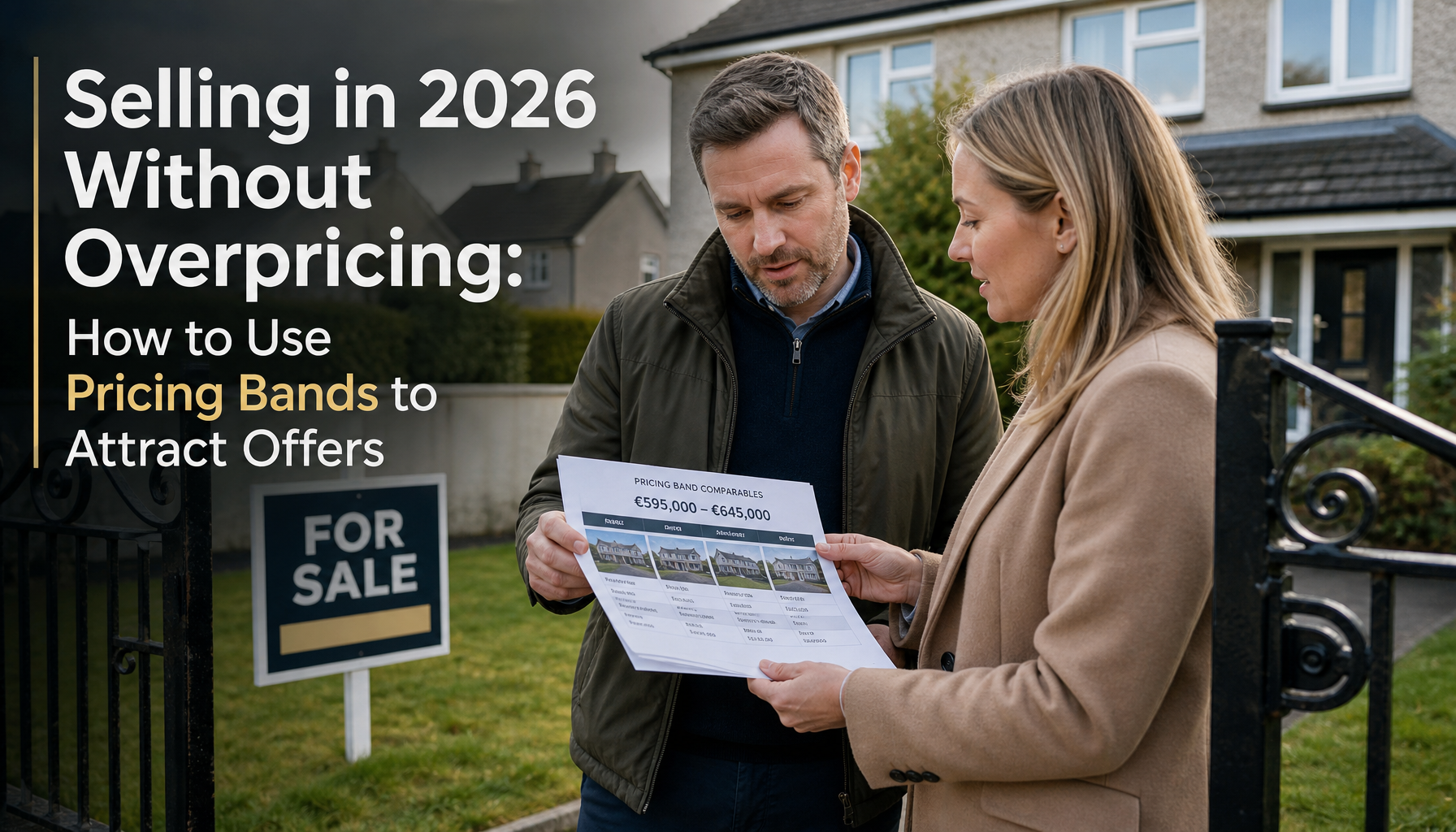
In 2026, buyer confidence can be uneven from one county to another, and even street to street. That means your selling price strategy Ireland 2026 needs to be more flexible than a single, hard headline number. One practical way to do this is to use pricing bands, setting your guide price so it signals the value range most likely to lead to viewings and early offers.
This approach is not about guessing blindly or “testing the market” with unrealistic figures. It is about structuring your price positioning so that buyers can quickly see that your property sits within the band they are prepared to consider. Done well, pricing bands can lower the overpricing risk and help you create momentum, which is often where strong outcomes are made.
Below is a practical guide to using pricing bands in 2026, how to build them from real comparable sales, what to say in the listing, and how to respond if the first wave of interest is slower than expected.
What are pricing bands, and why they work in 2026?
A pricing band is a deliberately defined price range you use to frame where your home is positioned in the market. For example, instead of communicating only one price point, you frame your guide to land in a range that matches what comparable buyers expect to pay for similar homes.
In practical terms, many buyers will not interpret a property in isolation. They benchmark it immediately against nearby sales, current listings, and the “feel” of what their peers are paying. If your headline price sits at the very top of those expectations, you can lose early interest, and you may find you have to reduce price later. That delay can be costly, both financially and emotionally.
Pricing bands reduce that friction. They help you:
- Attract viewings from buyers who can comfortably stretch to your band rather than only the very top end
- Encourage buyers to make an offer earlier because they feel the property is “within reach”
- Keep competition alive, which often supports better negotiations
Importantly, pricing bands can still respect your target outcome. The idea is to communicate a realistic entry point and allow room for negotiation within that structure, rather than asking buyers to jump to your number first.
Build your pricing band using comparable evidence, not optimism
To use pricing bands responsibly, you need a clear evidence base. Start with sales and listings that are genuinely comparable: similar property type, similar size, similar condition, and comparable location. In 2026, the market can move quickly, so focus on the most relevant, recent data you can access and cross-check multiple sources where possible.
Then, map your comparables to form a range. A simple method is to group evidence into three layers:
- Strong matches - homes that are closest in type, condition, and location. These set the “centre” of the band.
- Possible matches - homes that are slightly larger, smaller, older, or on a less ideal road. These help you understand the edges.
- Outliers - properties that are very different in finish, layout, or location. These are usually best treated as context, not anchors.
When you identify your band, remember what buyers notice. They tend to look for clarity: a home should not feel overpriced relative to the nearest comparable opportunities. Your job is to place your band where those buyers expect to see value.
If you want to deepen your approach, see the RightPlace guide on data and expectations in the buying journey through House Hunting in 2026: The 30-Point Viewing Checklist for Irish Buyers. Understanding what viewers pay attention to can help you refine your pricing band so it reflects what buyers are actually comparing.
Choose a band width that suits your property and your timeframe
Not every home needs the same band size. A townhouse on a busy road with limited parking might justify a narrower band because buyers will have more reasons to be cautious. A well-presented detached home with strong outdoor space might justify a slightly wider band if your condition and features create greater demand.
A useful rule of thumb is to align band width with two factors:
- Demand intensity: If comparable homes are attracting viewings quickly, a tighter band can work. If competition for similar stock is weaker, you may need a band that “catches” more cautious buyers.
- How quickly you need an outcome: If you are looking for early traction, a more inviting band may be better than a conservative one that depends on perfect timing.
Be cautious about bands that are too high. The overpricing risk is not only about missing the market today. It is also about training buyers to wait for a price cut. Once that perception forms, you can spend weeks competing with your own previous listing price.
How to present pricing bands in your listing, and why wording matters
Pricing bands work best when your listing communicates “range” rather than ambiguity. That means:
- Set a realistic guide price that sits within your band rather than at the extreme edge
- Make it easy to compare the property to others, by highlighting the features that justify your position
- Use clear descriptions of condition, improvements, and layout, because buyers will factor those into whether the property belongs at the top or bottom of your band
Think of your marketing as doing two jobs. First, it must attract viewings. Second, it must help viewers feel confident they are not being “pulled out of range” by a vague or inflated price. If you have a strong story, you can communicate value without sounding defensive.
If you are deciding how to work with an agent, the RightPlace guide Estate Agent Shortlist 2026: Questions to Ask Before You Sign a Mandate can help you compare how agents explain pricing and negotiation strategy.
Reduce the overpricing risk with a pre-agreed pricing response
One reason overpricing can linger is that vendors react slowly or without a plan. With pricing bands, you can pre-agree a response framework.
Before launch, decide what counts as “good early traction” and what counts as “we need to adjust.” For example, you may define:
- Strong traction: a steady flow of viewings and active questions about availability and form of sale
- Mixed traction: viewings occur but offers are limited or buyers ask for a price reduction quickly
- Weak traction: few viewings and repeated feedback that the property feels above what buyers are willing to pay
When you set your band, also set what you would do next if feedback suggests the property sits above buyers’ comfort level. That might involve revisiting your guide, tightening your messaging, or scheduling additional prep work to address perceived gaps. The key is to act while attention is still there.
For many sellers, momentum is everything. A property that is newly listed can generate curiosity. A property that appears “stuck” can lose it. Your band strategy is partly about protecting you from that situation.
Pricing bands and buyer psychology, what you should expect from offers
It can be useful to think about how buyers approach offers. Many buyers will:
- Check whether the property is likely to trade near the lower part of the band
- Ask themselves what they would pay for the home after factoring in condition, timeline, and similar options
- Expect negotiation, especially when the market feels selective
If your band is realistic, you are more likely to see early offers that sit within the negotiation range. If your pricing is too aggressive, you may only attract buyers who are willing to “roll the dice” or who have fewer competing options. That can lead to fewer offers and slower decision-making.
In 2026, buyers are also influenced by broader market narratives and affordability considerations. While you cannot control those influences, you can control how quickly your property becomes visible as a good fit in their decision-making process. For broader context on business and market conditions, you can also monitor reporting from RTÉ News Business as part of your own situational awareness.
Getting your next step right, where to start on RightPlace
If you are planning your sale in 2026, start by working out where your home sits relative to what is available now. Browse comparable properties and paid attention to how listings present value, not just price. Then choose a guide that reflects a believable pricing band.
You can explore current listings at Properties for sale in Ireland. If you are considering alternatives or timing, you may also want to see how demand plays out across different tenures by browsing Properties to rent in Ireland. For sellers in new-build or semi-new settings, New homes in Ireland can help you understand how buyers compare standard to finish.
Finally, remember that pricing is only one part of selling. A well-prepared home paired with a credible band can outperform an excellent home priced too high. And if your agent suggests moving away from a band-based approach, ask why, and request an explanation anchored to comparable evidence.
A practical checklist for using pricing bands in 2026
- Collect comparable evidence from similar properties in the right areas, and focus on the most relevant recent transactions.
- Set your band centre using strong matches, then check the lower and upper edges with possible matches.
- Pick a band width that matches demand and your timeline, without drifting into overpricing risk.
- Make the listing clear with features and condition details that explain why the property belongs in the chosen band.
- Agree a response plan in advance for what you will do if traction is weaker than expected.
- Monitor feedback early, not after weeks of low interest, so you can correct course while attention still exists.
When selling price strategy Ireland 2026 is approached through pricing bands, you are giving the market a clear invitation. You are positioning your home where buyers can see value quickly, and where offers are more likely to arrive within a negotiation range that protects your outcome.