Selling in 2026: pricing strategy for Irish homes when buyer sentiment is shifting
Selling · By David S · 7 August 2026
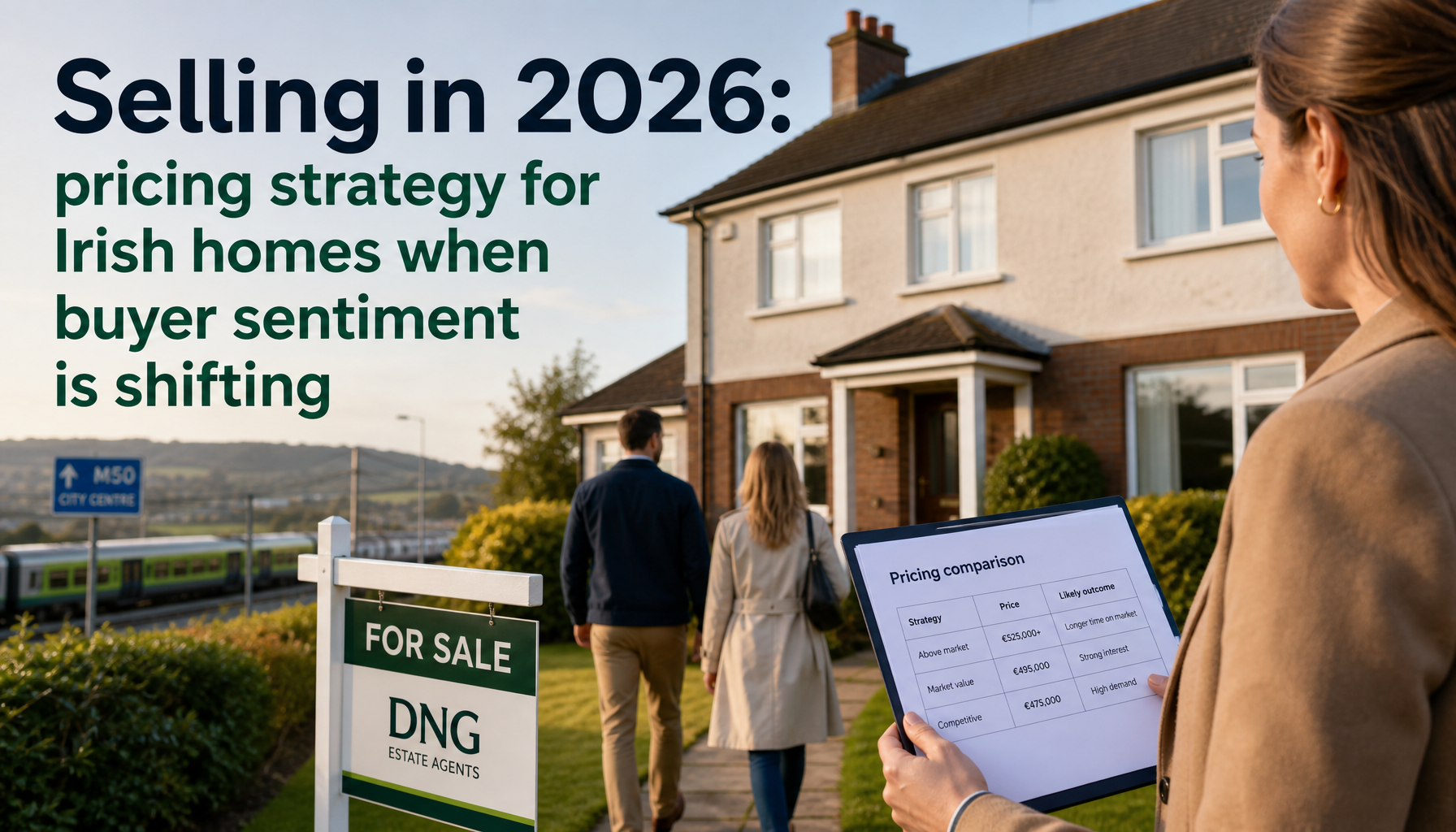
Selling in 2026 is rarely a simple question of “set a price and wait”. In many Irish locations, buyer sentiment can change quickly, and that affects how quickly interest turns into viewings and offers. The challenge for sellers is to price in a way that reflects today’s demand, while keeping options open if conditions shift further. This guide focuses on practical steps you can take to support a sensible home pricing Ireland approach, reduce avoidable delays, and protect your time on market.
For context, the wider Irish property market continues to be influenced by a range of factors, including financing conditions and broader business and consumer sentiment. For regular updates on property developments, it can help to keep an eye on reputable market coverage such as Irish Times Property, while wider business context is covered by RTÉ News, Business.
1. Start with market sentiment, not just your target price
When people talk about market sentiment, they usually mean whether buyers feel confident enough to move now. In practical terms, sentiment shows up in behaviour: fewer viewings, more “watching the market”, longer gaps between viewing and decision, and sharper negotiation. In that environment, even a well-presented home may sit longer if the asking price is out of step with what buyers think is fair value.
To ground your pricing in sentiment, ask your selling agent to help you compare three things:
- Comparable sold or agreed sales for the closest match you can find (same estate or street if possible, similar size and condition).
- Comparable asking prices in the same area right now, because asking prices influence buyer expectations even before deals complete.
- Buyer activity, such as how quickly similar homes are getting viewings and offers, and whether price reductions are happening.
If buyers are cautious, you may need to build in a margin that allows negotiation without undermining momentum. That does not automatically mean “price low”, but it does mean pricing should be defensible based on what buyers can benchmark today.
2. Use a pricing range and set a decision date
Many sellers set a single number and then react emotionally if the market does not respond. A more controlled approach is to agree an asking price range with your agent and set a decision date for reviewing it.
In 2026, a sensible structure could be:
- Pick an initial asking price that targets strong early interest, not just a maximum figure.
- Agree on a “go-to” price level if feedback is weak and viewings are limited.
- Agree on what data you will use to make the change, such as number of viewings, quality of enquiries, and whether buyers request lower offers.
Why this matters is simple: in changing sentiment, delays can compound. If a home remains overpriced, early buyers who would have moved may decide it is not worth considering. Later buyers may treat it as a test case and negotiate more aggressively. By deciding in advance when to review your strategy, you reduce the risk of letting time on market drift.
3. Separate “value for you” from “value for buyers”
Home pricing Ireland is often influenced by what sellers remember from the market in earlier years, or by replacement cost logic. Buyers, however, make decisions based on comparison and affordability in the current moment. In a shift in sentiment, buyers can be more selective about condition, layout, parking, energy performance, and renovation risk.
Consider how buyers may assess your home in 2026:
- Condition and readiness: Can a buyer move in with minimal works, or does the home “need doing”?
- Layout suitability: Is the room configuration aligned with current lifestyle expectations?
- External appeal: Gardens, boundaries, and any visible maintenance issues can strongly affect first impressions.
- Energy and comfort: Even without quoting technical performance, comfort and ongoing costs influence what buyers feel is “fair”.
If your home has strengths, you may be able to sustain a firmer asking price. If there are known works, you will likely need to price to reflect that buyer perception, or be prepared to invest in presentation and targeted improvements before listing.
4. Pricing differs by property type and buyer pool
In selling in 2026, one size does not fit all. A three-bed semi in a commuter area may compete for a different audience than a larger home with multiple reception rooms, or than a property with a unique layout. Even within the same county, demand can vary by neighbourhood micro-market.
To tailor your pricing strategy, focus on your most realistic buyer type:
- Owner-occupiers often prioritise livability, schooling access, and move-in readiness.
- Investors may price around rental yield expectations and running costs, though their decision-making can still be affected by financing conditions.
- First-time buyers can be sensitive to affordability and deposit size, and their search criteria may narrow quickly in a cautious market.
If you want a broader sense of what first-time buyers face, RightPlace.ie has guidance such as First-Time Buyers: How to Maximize the Help to Buy Scheme in 2026 and First-time buyer reality check in 2026: deposit size, approval, and waiting times. While those are buyer-focused, they can help sellers understand how certain segments think about timing and affordability.
5. Presentation and pricing must work together
Pricing alone cannot fix weak presentation, and presentation alone cannot justify a price that buyers view as out of line. In a sentiment shift, buyers scrutinise more, ask more questions, and compare harder between listings. That means the listing experience becomes part of the “value” equation.
Practical improvements that can support pricing without overpromising include:
- Declutter and depersonalise so viewers can imagine their own furniture.
- Improve kerb appeal with simple, visible maintenance (trim hedges, clean pathways, refresh lighting where needed).
- Ensure the home “reads well” in photos, with good daylight and clear sightlines.
- Address obvious maintenance concerns that can dominate negotiation later.
If your home is a new-build or close to new, you may want to align your marketing with typical snagging expectations. RightPlace.ie’s New-build homes in Ireland in 2026: checklist for snagging, timelines, and viewing new estates is useful for understanding how purchasers think about timelines and process.
6. Managing time on market, when offers start to slow
Time on market is not just a statistic. It influences buyer psychology. In 2026, if a home is on the market for longer than expected, some buyers assume there is a problem, or that the seller is more motivated than they first signalled. That can lead to tougher offers, not necessarily because the property has changed, but because the narrative has.
To manage time on market effectively, consider a structured response plan:
- Early phase (first weeks): Focus on generating strong viewings with clear pricing and compelling marketing.
- Mid phase: If enquiry quality is weak, adjust how you present the home, not only the number. Are viewings converting into offers?
- Later phase: If there is consistent negative feedback and low buyer traction, a price review may become necessary. A small, well-timed adjustment can sometimes restart interest more effectively than extended stagnation.
Be cautious about making frequent changes without a rationale. Buyers and agents talk, and a constant shuffle can create uncertainty. Instead, treat a price review as a calculated step based on evidence.
7. Avoid common pricing traps in 2026
When buyer sentiment shifts, certain habits can undermine results. Here are practical pitfalls to avoid when selling in 2026:
- Anchoring too high: A price set far above what buyers benchmark can stall viewings, which then reduces bargaining credibility.
- Ignoring local micro-markets: Prices do not move uniformly across Ireland. Even neighbouring towns can behave differently based on commuter links and local supply.
- Over-relying on historical prices: Past sale outcomes can inform value, but buyers act on current comparisons and confidence.
- Waiting for sentiment to “turn”: Momentum often declines faster than sellers expect. If feedback is consistent, it is better to respond early with a pricing and marketing plan.
8. Get the pricing discussion right before you list
The most useful selling conversations in 2026 are the ones that clarify process. Before you list, ask for:
- A written summary of comparable evidence used to set home pricing Ireland.
- An agreed view on target buyer profile and how that influences price.
- How the agent will monitor market sentiment and view activity during the first listing period.
- A clear “if X then Y” plan, including when and how you would consider a price review.
That last point is crucial because it turns pricing into a managed strategy rather than a reaction. If buyer sentiment changes, you will have a framework that helps you make decisions quickly and calmly.
9. When to broaden your search, and when to stay focused
Depending on your property, you may also consider how broader demand influences price. For example, some buyers look specifically for commuter towns and “where to buy for affordable living”. If that matches your location, it can be useful to read related RightPlace.ie guidance, such as The Rise of Commuter Towns, Where to Buy for Affordable Living in 2026 and Best commuter towns near Dublin in 2026 (with what you’ll actually pay).
For sellers who are unsure whether their home’s demand is best framed as owner-occupier or investor, it can also help to review current listings, including alternatives such as Homes for sale on RightPlace to see how similar properties are being marketed. Staying aware of how competing homes present value can prevent your price from being undermined by a weak comparison story.
Conclusion: pricing in 2026 is an active process
Selling in 2026 works best when pricing is treated as a responsive strategy, not a one-off figure. By grounding your asking price in buyer benchmarking, aligning presentation with the value buyers perceive, and managing time on market with clear decision points, you place your home in the best possible position even when market sentiment is shifting.
As always, if you have specific circumstances, consider getting professional guidance from relevant experts before acting on any major decision. In a market where confidence can move, clarity and timing often matter as much as the number on the sign.