Ireland Property Price Register May vs June 2026, What Sold Prices Tell Us
By David S · 3 July 2026

Ireland Property Price Register: What May and June 2026 Tell Us About the Market
The Property Price Register gives us one of the clearest views of what is actually happening in the Irish housing market. Asking prices are useful, but they only tell part of the story. The Property Price Register shows what homes actually sold for.
For this article, I looked at two files, May 2026 and June 2026, and compared the sales recorded across Ireland. I have focused mainly on full market price sales, because properties marked as “Not Full Market Price” can include family transfers, discounted sales or other cases that do not give a clean picture of the open market.
One important thing to say from the start, the June file provided runs up to 26 June, so the number of June transactions should not be read as a straight drop in activity. Property Price Register data also has a natural delay, because sales are added after they are completed and registered. So this is not a perfect real-time snapshot, but it is still a useful look at what was happening across the market.
The headline numbers
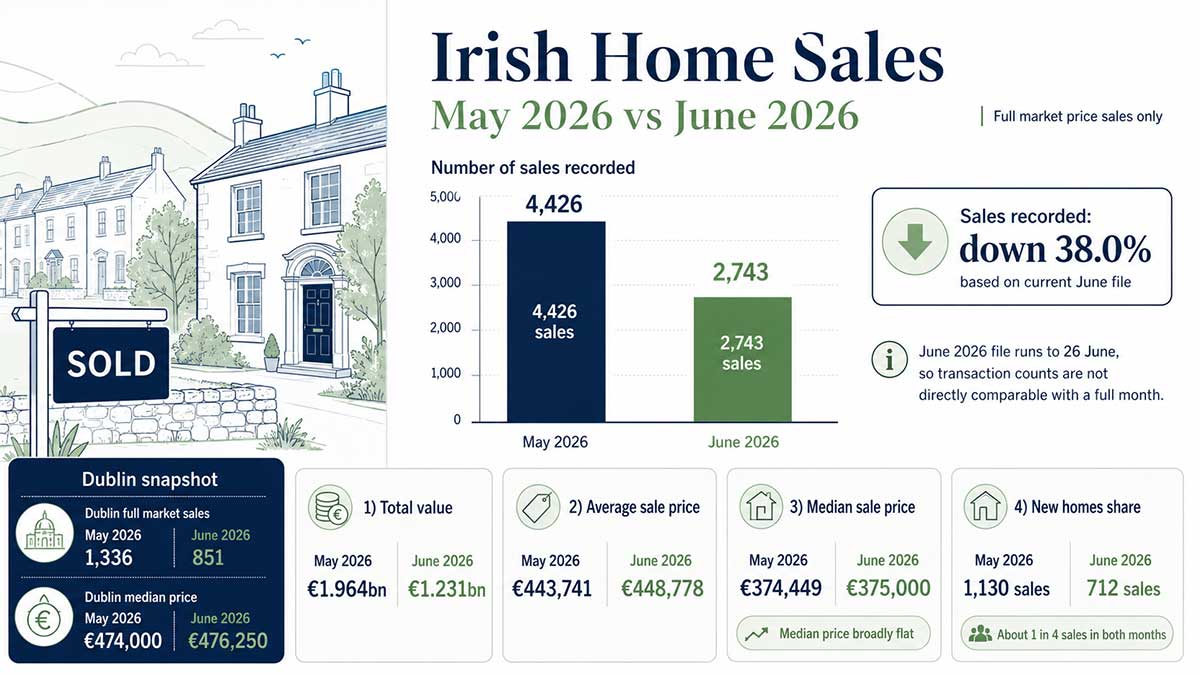
In May 2026, there were 4,426 full market price property sales recorded in the file. The total value of those sales was just over €1.96 billion. The average sale price was €443,741, while the median sale price was €374,449.
In June 2026, there were 2,743 full market price sales recorded in the file. The total value came to just over €1.23 billion. The average sale price was €448,778, while the median sale price was €375,000.
At first glance, June looks much quieter than May. But again, that needs to be treated carefully because the June file only runs to 26 June and later registrations may still be added. What is more interesting is that prices did not fall back. In fact, the average price moved slightly higher, and the median price was almost unchanged.
That matters because the median is usually the better figure to watch. Averages can be pulled around by very expensive homes or bulk purchases of new homes. The median tells us the middle point of the market. In May, the median was €374,449. In June, it was €375,000. That is basically a flat market month to month, but at a high level.
So the simple version is this, based on these two files, June had fewer recorded sales so far, but prices stayed very steady.
Dublin still dominates the market
Dublin remains the biggest force in the Irish property market by a long distance.
In May, Dublin had 1,336 full market price sales, worth around €853 million. That means Dublin accounted for about 30% of full market sales by volume, but over 43% of the total value.
In June, Dublin had 851 full market price sales, worth around €548 million. That was around 31% of full market sales by volume, and just over 44% of the total value.
This is the Dublin market in one sentence, it does not just have more sales, it has more expensive sales.
The Dublin median sale price was €474,000 in May and €476,250 in June. That is a small increase, but the bigger point is how far ahead Dublin remains compared with most of the country.
For buyers, this helps explain why the commuter belt keeps getting so much attention. When the middle of the Dublin market is sitting around €475,000, many people naturally start looking at counties like Kildare, Meath, Wicklow and Louth.
Cork, Kildare and Galway remain key markets
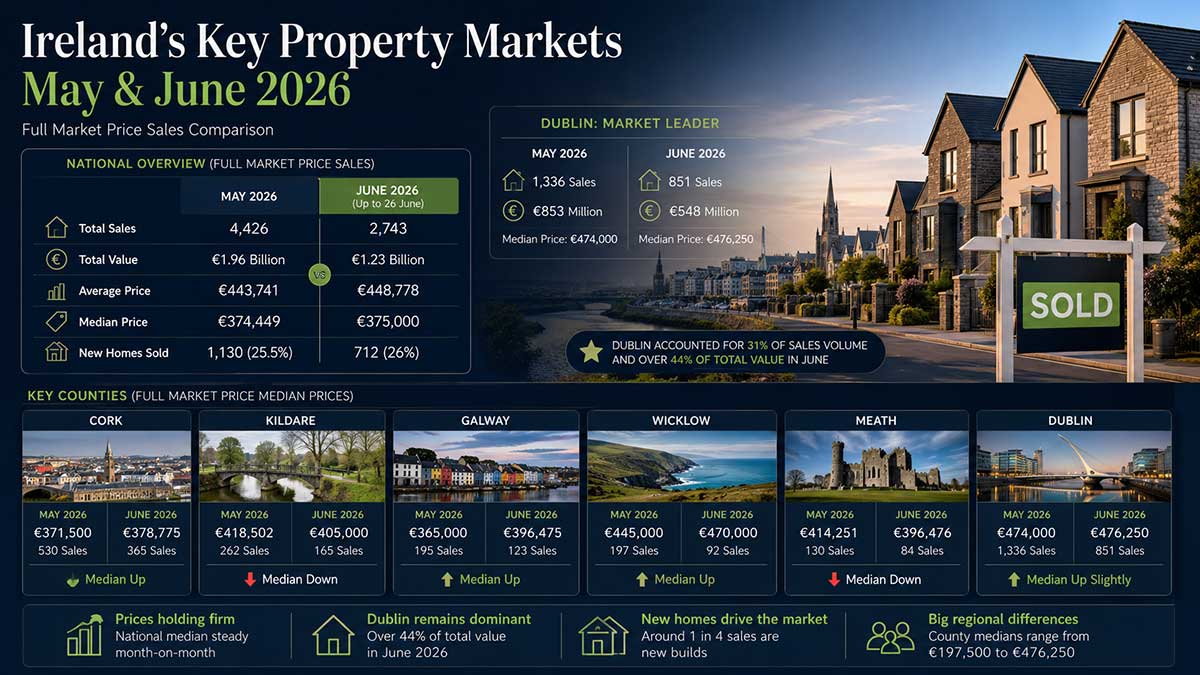
Outside Dublin, Cork had the highest number of sales in both months.
In May, Cork recorded 530 full market sales with a median price of €371,500. In June, Cork recorded 365 full market sales with a median price of €378,775. That is a small but noticeable increase in the median.
Kildare is also worth watching. In May, it had 262 full market sales with a median of €418,502. In June, it had 165 sales with a median of €405,000. The median dipped slightly, but Kildare remains one of the more expensive counties in the country. That is not surprising, given its commuter appeal and the amount of new housing around places like Naas, Maynooth, Celbridge, Leixlip and Newbridge.
Galway moved from a median of €365,000 in May to €396,475 in June. That is a strong jump, although we always need to be careful with one-month changes because the mix of homes sold can change quickly. If more higher-value homes are included in one month, the median can move up without it necessarily meaning every home in Galway has suddenly become more expensive.
Wicklow also stayed very high. It had a median of €445,000 in May and €470,000 in June. That puts Wicklow very close to Dublin levels, which shows how expensive the east coast market has become.
Meath, another key commuter county, had a median of €414,251 in May and €396,476 in June. So it softened slightly in this data, but still remained far above many counties outside the Greater Dublin Area.
The price bands show where most sales are happening
One of the more useful ways to look at the market is by price band.
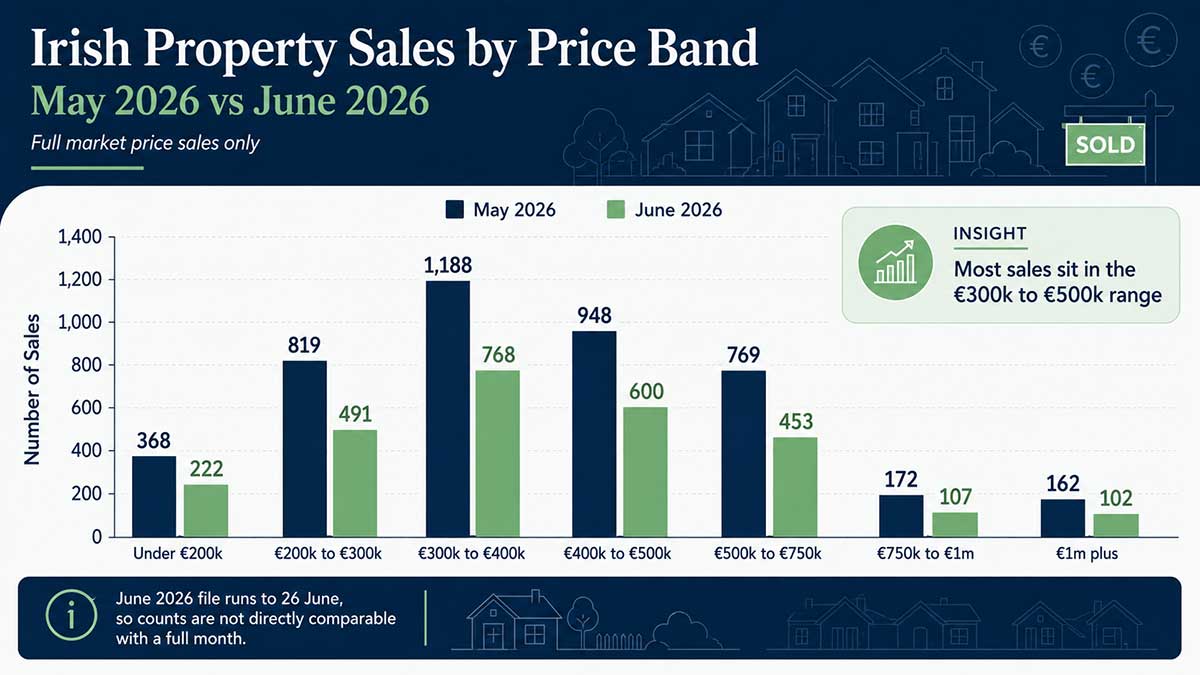
In May, the largest group of full market sales was between €300,000 and €400,000, with 1,188 sales. The next largest group was €400,000 to €500,000, with 948 sales. There were also 819 sales between €200,000 and €300,000.
In June, the same pattern continued. There were 768 sales between €300,000 and €400,000, and 600 sales between €400,000 and €500,000. The €200,000 to €300,000 range had 491 sales.
This tells us the centre of the Irish market is no longer really under €250,000 in many areas. There are still plenty of sales under €300,000, especially outside Dublin and the main commuter counties, but the busiest part of the market is sitting between €300,000 and €500,000.
That is a big issue for first-time buyers. If a household is trying to buy around the national median, they are looking at roughly €375,000 based on these files. In Dublin, that figure is closer to €475,000.
New homes make up around a quarter of sales
New homes are another major part of the picture.
In May, 1,130 of the full market price sales were listed as new dwellings. That is about 25.5% of full market sales.
In June, 712 full market sales were listed as new dwellings. That is about 26% of full market sales.
So across both months, roughly one in four recorded full market sales was a new home.
That is a big number, and it shows how important new developments are to the market. It also means that when we look at average prices, we need to remember that some new-home entries can be bulk transactions. For example, the May file includes large multi-unit sales such as Swiftbanks Manor in Saggart and Cronin’s Wood in Killarney. The June file includes large new-home transactions such as Millfield View in Glasnevin and Magee Quarter in Kildare.
These large transactions are important, but they can distort average prices. That is another reason why the median is usually a better measure when trying to understand what a normal buyer might be facing.
High-value sales are still very visible
Both months included a number of very high-value transactions.
In May, there were 162 full market price sales at €1 million or more, and 30 at €2 million or more. The highest full market sale in the file was a large new-home transaction at Swiftbanks Manor in Saggart, recorded at over €42.5 million. On the second-hand side, sales included properties such as 48 Temple Road in Dartry at €5.055 million and 9 Clifton Terrace in Monkstown at €4.7 million.
In June, there were 102 full market price sales at €1 million or more, and 22 at €2 million or more. The highest full market sale was a large new-home transaction at Millfield View in Glasnevin, recorded at over €31.4 million. On the second-hand side, 18 Argyle Road in Donnybrook sold for €7.25 million, while 33 Orwell Park in Rathgar sold for €4.5 million.
These sales are not typical, but they do show the strength at the top end of the market, especially in Dublin.
For most buyers, these figures are more useful as context than as a guide. They show why averages can look higher than what many people see when browsing normal family homes.
Counties with the highest medians in June
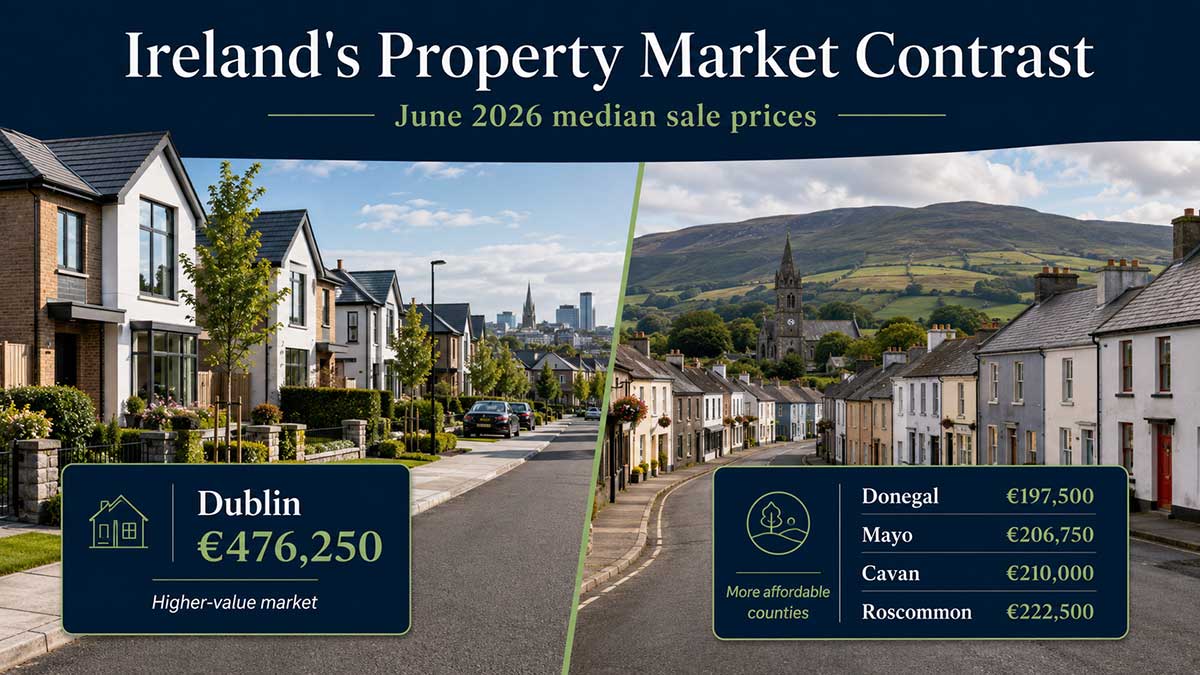
Looking at counties with a reasonable number of sales in June, Dublin had the highest median at €476,250. Wicklow followed closely at €470,000. Kildare came in at €405,000, while Meath and Galway were both around €396,000.
That tells a very clear story. The most expensive part of the Irish market is still concentrated around Dublin and the wider commuter belt, with Galway also showing strong prices.
At the other end, Donegal had a median of €197,500 in June. Mayo was €206,750, Cavan was €210,000 and Roscommon was €222,500. These counties still offer much lower entry points compared with Dublin and the east coast, although local wages, supply and location all need to be considered.
This is one of the biggest divides in the Irish property market. The same national market contains Dublin homes selling around a median of €476,000, and counties where the median is closer to €200,000.
What does this tell us about the market?
The biggest takeaway is that prices are holding firm.
May and June look different in terms of transaction numbers, but the median price barely moved. May’s full market median was €374,449 and June’s was €375,000. That is about as steady as it gets.
Dublin remained dominant, Cork remained the biggest market outside Dublin, and the commuter counties continued to show high prices. New homes made up about a quarter of full market sales in both months, which shows how much the market depends on new supply.
The data also shows why it is risky to judge the market by one figure. The average price is useful, but it can be skewed by bulk sales and luxury homes. The median gives a better feel for the middle of the market. County-level figures are even more useful, because the Irish market is not one single market. Dublin, Wicklow and Kildare are operating at a very different price level to Donegal, Mayo or Cavan.
For buyers, the message is that there is still strong competition in the main cities and commuter areas. For sellers, the data suggests that prices remained resilient across May and June. For anyone watching the market, the next few months will be important, especially to see whether the summer brings more supply and whether mortgage affordability starts to cool demand.
Based on these two Property Price Register files, there is no obvious sign of a major price drop. Instead, the market looks steady, expensive in the main demand areas, and still heavily shaped by Dublin and new-home activity.