Mortgage basics for 2026 buyers: understanding repayment vs term trade-offs
Mortgages · By David S · 6 October 2026
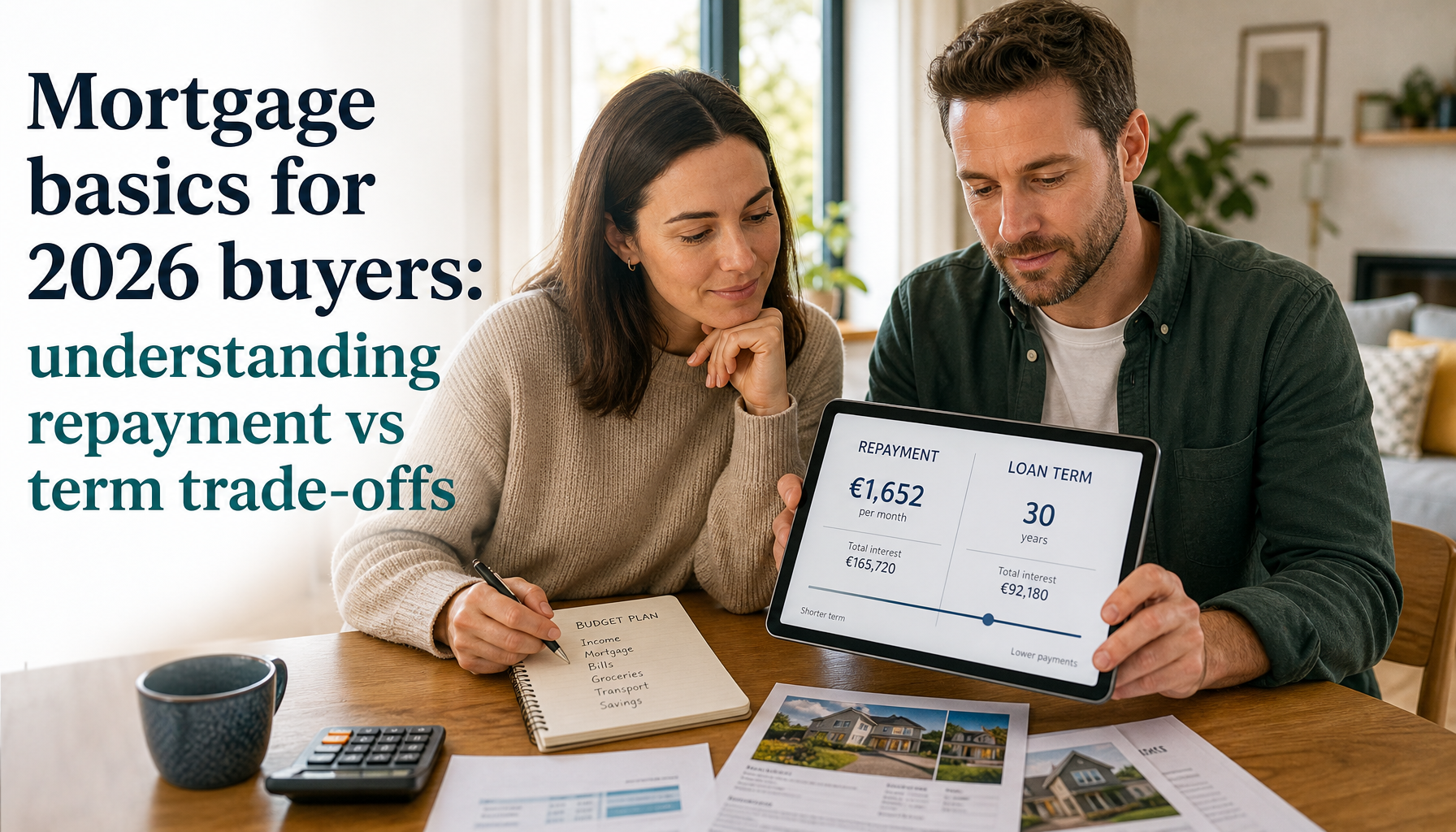
Buying in 2026 comes with plenty to juggle, from deposit targets to BER details. For most buyers, the biggest monthly decision is the structure of the mortgage itself. Two phrases come up again and again when you compare offers: mortgage repayment vs term. The link is simple, but the implications are not always obvious. A longer loan term usually lowers the monthly repayment, while a shorter term can increase the monthly payment but reduce the overall interest paid, which influences the total cost of the loan.
This guide explains the trade-offs in plain English, shows what to compare when you are looking at mortgage illustrations, and highlights the affordability questions worth asking before you commit. For official guidance on mortgages and consumer information, see the Central Bank consumer hub at Central Bank, Mortgages.
1) Repayment vs term, what the terms actually mean
In a typical mortgage, you repay both principal (the amount borrowed) and interest (the cost of borrowing). How these are spread out is heavily influenced by two choices or assumptions:
- Mortgage repayment: the amount you pay each month. This is what affects your day-to-day cash flow.
- Loan term: the length of time you have to repay the loan. Commonly, mortgages are set over multi-year periods.
When you stretch the term, the monthly repayment often falls. When you shorten it, the monthly repayment rises. The trade-off is mainly about how quickly you reduce the outstanding loan balance, which then affects how much interest you pay over the life of the mortgage.
It is also worth remembering that repayments depend not just on term, but on interest rate and product features. Even if two loans look similar on paper, small differences in rate, repayment structure, or assumptions can change what you pay month to month and over the long run.
2) Why a longer loan term can look easier for affordability
In practical terms, many buyers focus first on affordability because it is immediate. A longer loan term can reduce the monthly figure, which can help you fit the mortgage into your budget alongside household expenses, utilities, insurance, and the costs that come with owning a home.
However, affordability is not only about whether the numbers work today. It is also about how comfortable you would be if your circumstances change. For example, people may want to ask themselves:
- Is there room in the budget for unexpected expenses, such as appliance replacement, repairs, or temporary income disruption?
- How would your budget cope if interest rates rose, or if the mortgage product type led to higher repayments later on?
- Would you still be comfortable if you had to maintain savings for other goals, such as education or car replacement?
Central Bank guidance emphasises the consumer perspective on affordability and responsible lending, and it is good practice to read through the official materials before you proceed. You can start with the Central Bank mortgage consumer hub.
3) How term affects total cost over the life of the loan
While the monthly repayment may be the main headline, the total cost is what you ultimately pay. In general, paying off the loan balance more quickly reduces the time during which interest accrues on the higher remaining balance.
This is why a shorter term can be attractive even if the repayment is higher. In many scenarios, a shorter mortgage repayment vs term profile means you are paying more towards principal earlier. That can shift more of your payment from interest into loan balance reduction, lowering the interest portion overall.
To compare options properly, do not rely only on the monthly figure. Look for:
- Total interest or total cost over the term shown in the illustration.
- Assumptions used for interest rate and product features. If an illustration assumes a rate that does not reflect what you expect, the comparison can be misleading.
- Early repayment conditions, if you anticipate overpayments or want flexibility. Different products can treat overpayments differently.
Always treat mortgage illustrations as examples based on assumptions, not promises. If a figure seems too good to be true, ask for the detail behind it and check whether you are comparing like for like.
4) A practical way to compare mortgage options, step by step
When you are comparing two deals, you want to avoid apples vs oranges. Here is a practical process that works well for 2026 buyers:
- Step 1: Start with your target monthly affordability range. Decide what you can comfortably manage, not just what you qualify for. Include everyday bills and realistic living costs.
- Step 2: Compare at least two terms. For example, look at one option with a shorter loan term and one with a longer term. Keep the rest of the comparison consistent as much as possible.
- Step 3: Check the full illustration. Compare total cost, not only repayments. Pay attention to the breakdown between interest and principal where it is provided.
- Step 4: Consider product timing. If one option has features that change later, make sure you understand how repayments might evolve. Ask what happens at key points in the mortgage life.
- Step 5: Stress test gently. You do not need to predict the future, but you can ask how your budget feels if repayments were higher than the initial illustration. This gives you a sense of resilience.
If you are exploring homes in parallel, you may find it helpful to keep your affordability envelope in mind when browsing listings, such as on property-for-sale. The more you align the mortgage structure with the property choice, the fewer last-minute compromises tend to show up.
5) The affordability trap, when a low repayment hides risk
A low monthly repayment can be tempting, especially in a year where the cost of living and property running costs still matter. The risk is that a mortgage that feels manageable today can become tight if life changes.
Some buyers choose a longer term primarily to reduce the monthly figure. That can be reasonable if the household budget is genuinely comfortable and there is a plan to manage future uncertainty. But it can become a trap if:
- Your repayment leaves little flexibility for emergencies.
- You are relying on income that is not stable or predictable.
- You assume future costs will not increase, such as energy bills, insurance, or maintenance.
- You are not factoring in other ownership costs, like property management or service charges where relevant.
One way to reduce the risk is to match the mortgage term to your risk tolerance. If you want lower monthly payments, consider whether you can also build a buffer that helps you through months where expenses are higher. If you prefer certainty, a shorter term may suit better, but only if the monthly payment is still truly comfortable.
6) How buyers can use the trade-off strategically
Even if you start with a longer loan term, you may be able to reduce total cost over time through additional repayments, depending on the mortgage product rules. Over time, some households plan to increase repayments when finances stabilise, such as after finishing renovations or when another bill decreases.
On the other hand, if you pick a shorter term from the beginning, you may benefit from lower interest costs, but you should be careful not to stretch so far that you cannot handle other priorities. The most sustainable plan is the one you can keep under real-world pressure, not the one that looks best in theory.
7) Common comparison mistakes to avoid in 2026
- Comparing repayments without total cost. A slightly higher repayment may lead to materially lower interest and total cost.
- Comparing different products without understanding features. Two mortgages can have different risks or repayment patterns even if the headline rate looks similar.
- Ignoring the impact of term on flexibility. If you might want to change your repayment pattern later, ask how the mortgage handles overpayments or early repayment.
- Forgetting that affordability is broader than the mortgage. A property that is affordable on the mortgage may still be costly overall if running costs are high.
8) Where the rest of your buying plan connects to the mortgage
The mortgage structure does not sit in isolation. Your choices connect to deposit planning, home condition, and the wider decision to buy in the first place. If you are still shaping your deposit strategy, RightPlace has a guide that can help you prepare your plan, including practical questions to ask before you apply, at Irish first-time buyers in 2026: how to prepare your deposit plan (before you apply).
Condition and energy performance can also influence affordability. If you are viewing homes, consider what a property’s energy performance means for ongoing bills. For a buying checklist that covers BER questions before you commit, see Buying a home in Ireland in 2026, what to ask about BER before you commit.
And if you are comparing renting and buying in 2026, a clear understanding of cash flow matters. A separate checklist is available at Renting in 2026: a landlord and tenant ‘fair expectations’ checklist to help you weigh day-to-day commitments.
9) Getting clarity, when to ask for professional help
Mortgage decisions are highly individual, particularly when you consider future plans, employment stability, and the specific product being offered. While this guide provides a framework, it is sensible to seek advice from qualified professionals to understand how a particular mortgage product works in your situation.
At a minimum, ask your lender or broker to explain what changes when you choose a different loan term, what drives the difference in mortgage repayment vs term, and how the illustration calculates the total cost. If something is unclear, it is okay to pause and request a breakdown.
Bottom line for 2026 buyers
In 2026, the trade-off between mortgage repayment vs term is about balancing what you pay each month against what you ultimately pay over the life of the loan. A longer term can support affordability by lowering repayments, while a shorter term can reduce interest and potentially lower the total cost. The best choice is the one that fits your household budget not only today, but through likely changes ahead.
Use illustrations as tools, not truth. Compare total cost, check assumptions, and make sure your repayment plan leaves room for real life. For current listings while you plan your buying journey, browse property-for-sale and explore options across different price points and property types.