Data-led: commuter belts vs city-centre demand in 2026, what it means for renters and buyers
Market Reports · By David S · 16 August 2026
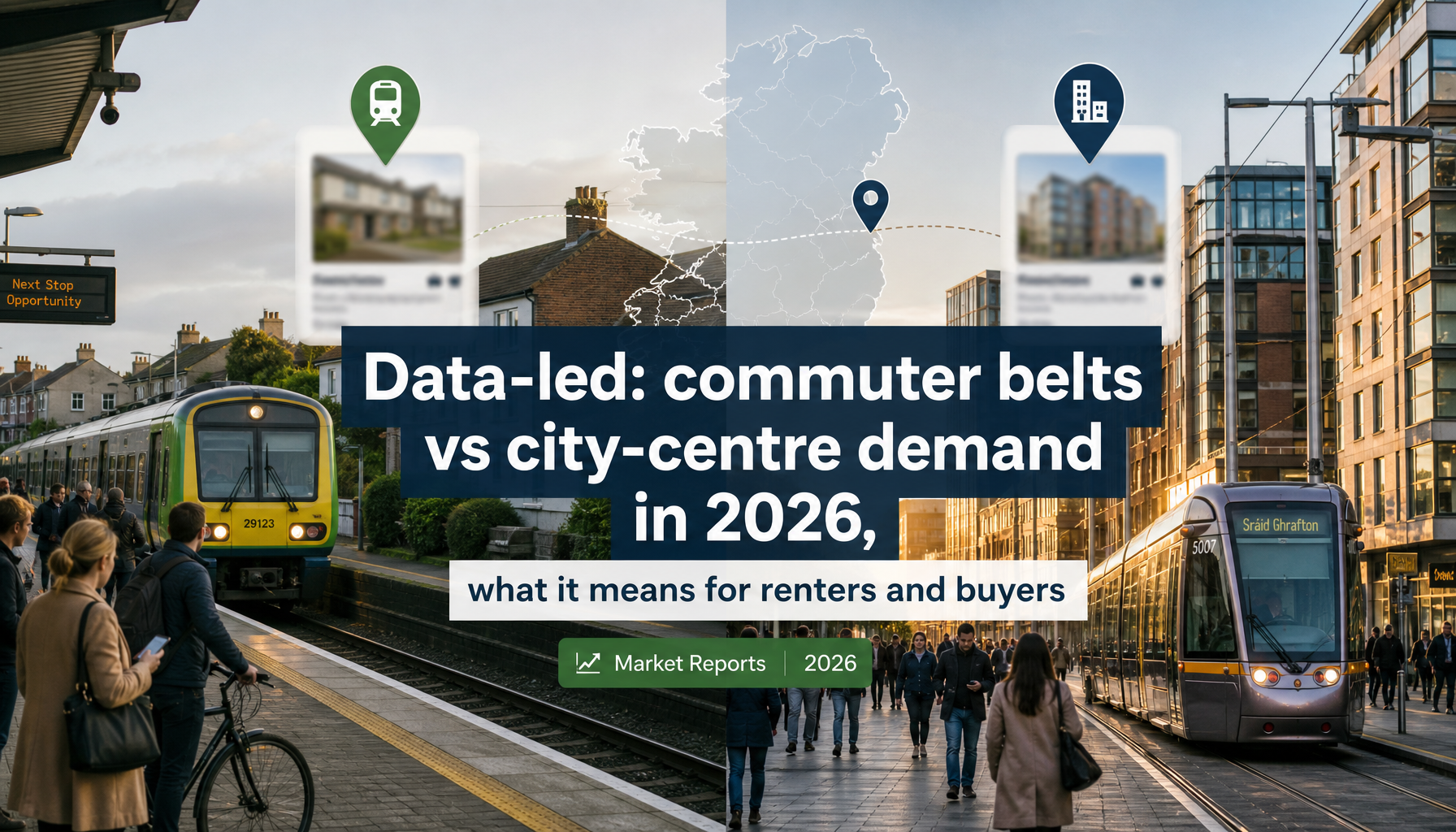
In 2026, Irish property demand is not moving in one direction. It is behaving more like two stories running in parallel: commuter belts that keep drawing people with everyday affordability and easier day-to-day life, and city centres that remain attractive for lifestyle, services, and proximity to jobs. For renters and buyers, the key is understanding how these patterns can affect rental availability, pricing expectations, and the practical choices you face when you are looking for a home.
This article is data-led in the sense that it frames the market using observable signals and commonly tracked indicators. It is not a prediction for one street or one estate. Instead, it helps you interpret what the overall housing demand 2026 split can mean when you plan a move, sign a tenancy, or make an offer.
What “data-led” means in the Irish market, in plain terms
When we talk about housing demand, we are usually looking at a mix of market signals rather than one single number. Those signals can include how quickly properties are finding buyers, how long listings sit on the market, the share of viewings that relate to certain areas, and the pattern of new supply. On the rental side, the focus tends to be on how many homes are actively available, the stability of rent asks over time, and how often tenants report a shortage of suitable options.
To keep this practical for RightPlace readers, the discussion below uses two broad market lenses: commuter vs city demand, and rental availability as it connects to day-to-day choice.
You can also keep a live view of availability and asking prices by browsing current homes for sale and rentals on the RightPlace site, including listings here: Homes for sale on RightPlace and Browse rentals on RightPlace.
Commuter belts, why demand holds up in 2026
Commuter towns and outer suburbs often combine three things that matter to many households: reasonable access to employment hubs, a wider range of property types (including family homes), and generally more land or space per budget. In 2026, those features keep demand resilient, particularly where buyers feel squeezed in more central areas and renters seek stability rather than constant relocation.
From a renter’s perspective, commuter belts can also help reduce the “choice gap”. When city-centre rental supply is thin, households often look outward. That can translate into more options at varying price points, although it is not a guarantee. Demand can still be strong, and family-sized homes can still be competitive.
From a buyer’s perspective, commuter belts can offer more “space for the money”, which is one reason many of the searches and viewings tend to cluster away from the centre during periods where budgets are tight. This can influence property trends Ireland by shifting which areas show more buyer interest, which in turn affects how quickly homes move and how aggressively sellers price.
If you are exploring this route, it is worth checking how new supply is distributed too. RightPlace also has a dedicated view of New homes for sale, which can be useful if you are deciding whether to buy a house now or wait for a later phase of a development.
City-centre demand, where it stays strong and where it softens
City-centre locations continue to carry appeal for renters and buyers who prioritise walkability, services, and shorter commutes. For some households, the city is also a lifestyle choice. That said, city-centre demand can fluctuate more visibly depending on affordability and the availability of suitable rental units.
In 2026, one reason the city-centre story can diverge from commuter belts is that the city offers more apartment living for many budgets, while commuter areas often offer more houses. If your household needs storage, outdoor space, or a spare room, your property options may narrow fast in the centre. That can influence how many listings translate into real viewings, not just how many appear in search results.
There is also a difference between being “close to the city” and actually being in the city core. Properties just outside the centre may capture part of the city pull while still offering more practical layouts. This creates a shifting ring of demand that can look, on the ground, like a gradual spread rather than a sudden drop.
If you are buying, make sure you look beyond headlines and check property specifics that affect value and livability, especially for apartments. If you are renting, focus on tenancy structure and suitability, not just the rent ask. For guidance, see Renting in Ireland in 2026: how to compare tenancies before you sign.
Rental availability in 2026, what the commuter shift can change
One of the clearest practical impacts of the commuter versus city split is on rental availability. When city-centre options tighten, you typically see three effects:
- Search radius expands, meaning renters consider more peripheral areas and shorter-listing competition moves outward.
- Demand concentrates on “usable stock”, such as family apartments that are large enough, or houses that match a household’s working-from-home needs.
- Tenancies can become more selective, where landlords choose between applicants more actively because supply is limited.
For renters, that can mean more time spent viewing, more urgency once a suitable place appears, and a stronger focus on conditions such as heating, parking, and transport links. If you are trying to avoid a stressful rental cycle, it can help to be clear on what you will compromise on and what you will not.
If you need flexibility, consider sharing options too. RightPlace has a section for House shares, which can be a practical step if you want to stay closer to the city while keeping your budget under control.
Buyer behaviour in 2026, how demand patterns affect offers
Demand does not just affect asking prices. It affects how buyers behave: how many viewings happen, whether buyers return for a second look, and how quickly decisions get made. In a commuter belt, competition can be brisk but often centred on certain property types, such as three-bedroom homes with parking, or properties within a manageable commute time.
In the city centre, buyers can face a different set of decision drivers, including building management and ongoing costs, plus the resale profile of the specific unit type. Even when a city is desirable, buyers may still be cautious if the property’s fundamentals do not match their long-term plans.
A “data-led” approach for buyers means tracking the supply-to-demand feel in each micro-market. A practical way to do this is to compare comparable listings and pay attention to how quickly similar properties attract interest. Use current listings on RightPlace Homes for sale as a starting point, then refine your search by commuting needs and property type.
When sentiment shifts, pricing strategy becomes more important. For sellers, there is a detailed guide available at Selling in 2026: pricing strategy for Irish homes when buyer sentiment is shifting. Even if you are not selling, it can help you understand how market expectations may be adjusting around you.
New builds vs established homes, where demand tends to land
In both commuter belts and city centres, new build demand can be shaped by who is trying to de-risk major repairs and who wants modern insulation standards and layouts. For buyers who value predictability, a new home can reduce uncertainty. For others, established properties may offer more character, larger sites, or better proximity to transport and schools, depending on the area.
To make sense of “property trends Ireland” in 2026, look at the balance of demand across both categories. If new builds are being absorbed quickly in one zone, that can be a sign the market is ready for that particular offer. If established homes in a certain pocket are moving slowly, demand might be focusing elsewhere, which loops back into the commuter versus city narrative.
New build buyers should also plan for the real timeline experience. This checklist can be useful: New-build homes in Ireland in 2026: checklist for snagging, timelines, and viewing new estates.
How to use this to plan your next move, renter or buyer
Regardless of where you are located now, the commuter versus city split suggests a simple planning discipline: decide your non-negotiables first, then map them to the most realistic property types in 2026.
Here is a practical framework you can apply:
- Work and commute reality: set a maximum travel time you can sustain, not just the “ideal” route.
- Property type fit: if you need a family home, commuter belts may offer more matching stock than the city centre.
- Budget and flexibility: consider whether you can flex on size, layout, or finishing level to widen choice.
- Availability horizon: decide whether you are prepared to move quickly if a suitable home appears, especially in areas where rental supply may be tighter.
- Future plans: if you may buy within 12 to 24 months, choosing an area with stable buyer interest can help reduce stress later.
Also, where you are renting, do not treat rent asks as the full story. Carefully compare conditions and tenancy terms. If you are buying, consider total ownership realities and discuss your specific situation with qualified professionals before committing to any major decision. This article offers market context, not personal financial or legal advice.
Where to watch next in 2026, and why it matters
Demand patterns evolve. In 2026, the key is to keep watching signals rather than relying on last year’s narrative. If you want a broader backdrop, you can follow ongoing business coverage relevant to housing and the economy, such as updates from RTE News at https://www.rte.ie/news/business/. That kind of reporting can help you understand macro pressures that feed into household decisions.
For RightPlace readers, the best “real-time” source is still current supply. Use RightPlace to track what is available and compare listings over time. If you are searching now, update your saved searches and be ready to act when the right match appears.
Ultimately, housing demand 2026 is not one simple story. It is a split between commuter belts and city centres, influenced by affordability, property type availability, and day-to-day lifestyle preferences. If you plan with that in mind, you can make smarter choices about where to rent, where to buy, and how to move with confidence in a market that is still actively changing.