Property market update 2026: how interest rates, buyer confidence, and supply interact locally
By David S · 8 November 2026
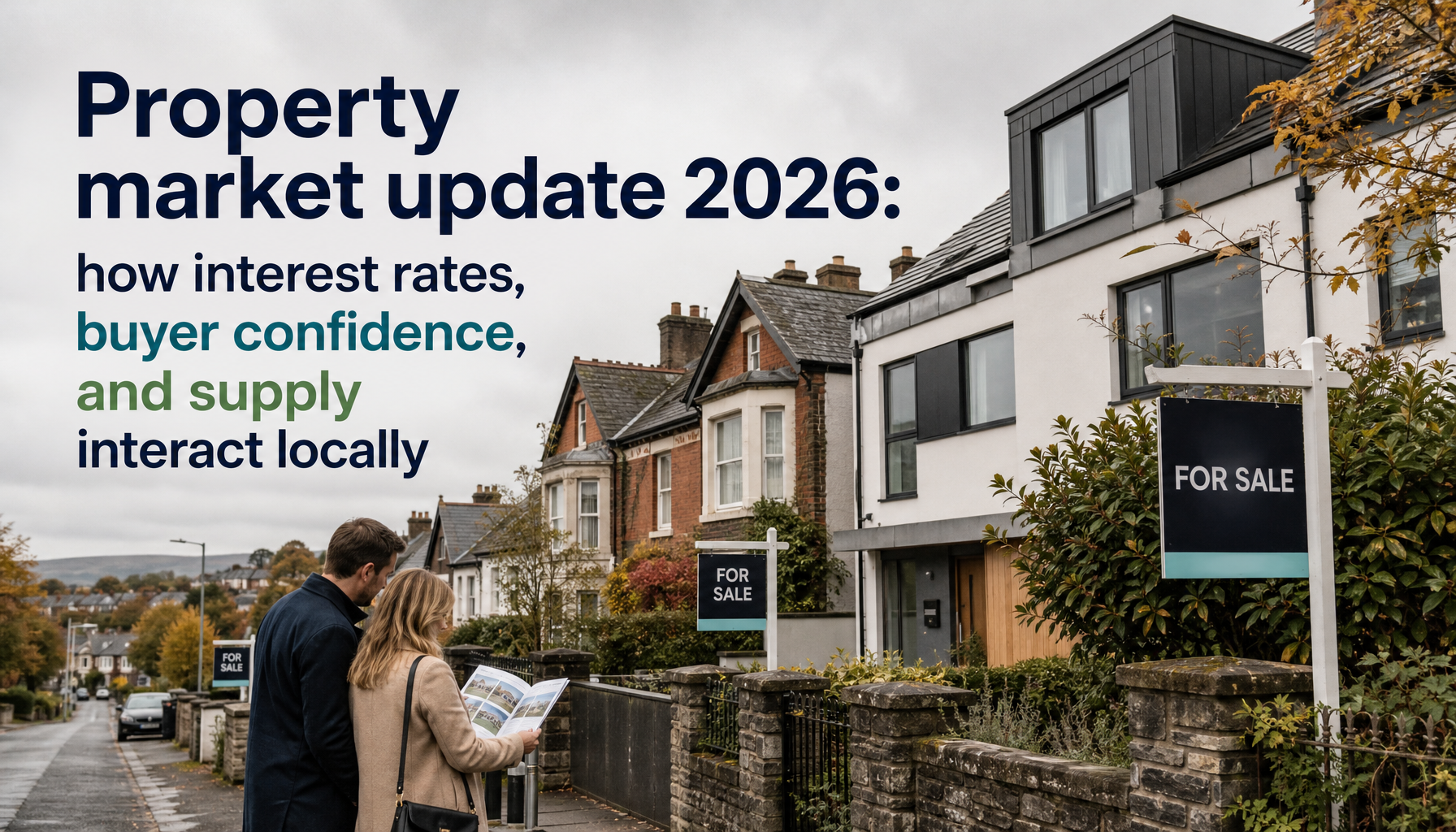
As we move through 2026, the Irish property market update 2026 story is less about a single headline driver and more about how three forces interact: interest rates, buyer confidence, and local supply. Together, they shape not only what people offer, but also the pace of transactions, the length of listings, and the level of negotiation you are likely to see from week to week.
For buyers and sellers, the practical question is simple: why does one property get attention quickly while another similar home sits longer? In most cases, the answer lies in how price expectations line up with borrowing realities and with what else is available nearby.
Interest rates in 2026, and why they show up in buyer behaviour
Interest rates influence affordability through monthly repayments. Even when buyers are broadly confident, day-to-day behaviour tends to reflect what lenders and households consider sustainable costs. In 2026, the market has continued to differentiate between buyers who are comfortable acting within their budget and those who wait for clearer signals or better value.
From an estate agency perspective, you often see a pattern like this:
- Sharper demand for ready-to-move homes, especially where the asking price feels aligned with recent transaction reality.
- More scrutiny on total cost, including service charges, insurance and ongoing maintenance, because households are working within a fixed borrowing envelope.
- Greater variation in negotiation, where properties priced with a realistic view of repayments can attract stronger competition.
It is worth keeping a close eye on official rate context and central bank commentary. For ongoing updates, you can follow information from Central Bank of Ireland and broader business coverage from RTÉ News Business.
Buyer confidence, time on market, and the “pricing conversation”
Buyer confidence is not just a mood. It is a practical assessment of risk, timing, and certainty. In 2026, confidence shows up in how quickly buyers move from viewing to making offers, and how they respond when sellers hold firm or adjust pricing.
Time on market is one of the clearest signals of where confidence and supply are meeting. While there is no single average that fits every county and neighbourhood, the market tends to respond quickly to mismatch:
- If a property’s price is in step with what comparable homes are being discussed for, it can attract multiple enquiries and shorten time on market.
- If the asking price is ambitious relative to borrowing realities and local competition, listings can drift, and buyer interest may soften over time.
- When confidence is cautious, buyers often ask for clarity earlier, such as on condition, documentation, and what work, if any, may be needed.
From the buyer’s side, confidence often means they can move decisively once they identify a home that suits both lifestyle and budget. From the seller’s side, confidence can mean they understand how much they need to be flexible on price or timeline to match that decisiveness.
If you are buying, it helps to treat each viewing as part of a broader information gathering exercise. Cross-check the condition, parking and access, any known service obligations, and whether the property offers what buyers in the immediate area can realistically choose from.
Local supply in 2026, and why “more listings” does not always mean easier buys
Supply matters, but it matters locally. “The market” can look one way nationally while your street or commuting corridor behaves differently. In 2026, supply interacts with demand in a way that can surprise people.
Consider what happens when more homes come to market:
- Competition can increase if sellers price aggressively, because buyers then have better options and can take more time comparing.
- Selection can improve for specific needs, such as school catchments, transport access, or layouts that suit particular household types.
- But demand can also shift, meaning buyers may concentrate on the best-value properties, leaving average homes with longer time on market.
So rather than assuming “more supply equals lower prices,” a more useful approach is to watch for which homes are gaining momentum. If listings are plentiful but only a subset attracts offers, the issue is usually value perception, not just quantity.
For sellers, it is particularly important to assess supply through a local lens. The right pricing strategy in one neighbourhood can be the wrong approach in another, even within the same county.
What this means for time on market, and what to look for as a buyer
If you are tracking listings in your target area, time on market is a window into buyer confidence and supply pressure. In 2026, the most helpful viewing questions are not abstract. They are specific and practical.
As a buyer, you can look out for:
- Consistency between listing details and what you see, including layout, condition, and any obvious maintenance issues.
- Signs of clarity in documentation and readiness, which can speed up decision-making when confidence is present.
- Whether similar homes are competing for the same buyer pool, which can affect how quickly you need to act.
- How the property has been marketed, because good presentation helps buyers connect the home to their lifestyle rather than to a vague “maybe.”
If you want a broader view of listings across price bands, it can also be useful to browse current options on /property-for-sale and consider how newly listed homes are clustering in your chosen areas.
What this means for sellers, and why pricing readiness matters in 2026
Sellers often feel the market through enquiry volume. In 2026, a property can receive interest but still not sell quickly if buyers see better value elsewhere. That is why many sales fall into one of two categories: either the home was priced to meet the moment, or it needed a later adjustment.
A seller’s best chance of reducing time on market is not just choosing a number. It is aligning three elements:
- Condition and presentation, so buyers can imagine living there without an immediate list of fixes.
- Price expectation, grounded in local comparable sales and what borrowers can realistically afford.
- Offer readiness, including the ability to respond quickly and keep momentum once interest is strong.
Practical guidance can also help you plan your next steps. If you are considering selling, this may be a useful read: Selling in 2026: the offer readiness playbook to reduce sale fallout.
New builds and staged payments, a different angle on confidence
In 2026, new homes remain a distinct segment because purchasing involves a different timeline and set of expectations. Buyer confidence here often revolves around delivery certainty and what is verified before each stage of payment.
If new-build is part of your plan, it is worth reviewing a checklist approach and speaking to the developer or your advisor where clarity is needed. You can also refer to New build buyer’s checklist for 2026: what to verify before you pay the next tranche.
Delivery and snagging expectations can also affect the effective timeline for buyers. For more detail on what timelines and move-in steps can involve, see New homes in 2026: timelines that actually matter, site handover, snagging, and move-in.
Where to watch the next signals in the Irish property market update 2026
Because the market moves through interactions, it helps to monitor multiple signals rather than one number. In 2026, you can keep your finger on the pulse by following:
- Central bank updates for the broader policy and economic context, via Central Bank of Ireland.
- Business coverage that explains how developments may translate into consumer sentiment and borrowing conditions, via RTÉ News Business.
- Property reporting that tracks market narratives and regional movements, via The Irish Times Property.
At RightPlace.ie, we also encourage readers to combine online research with local knowledge. Browse options, save listings that fit your criteria, and pay attention to how quickly homes appear to attract attention. If you are comparing areas, consider reading an area guide that matches your commuting pattern or life-stage needs, such as Area guide 2026: best commuter towns near Cork City for renters and first-time buyers.
Bottom line, the market is local and timing-driven in 2026
The Irish property market update 2026 takeaway is that interest rates shape affordability, buyer confidence determines whether people act, and supply influences the choices available. When these align, properties can sell faster and negotiation feels more constructive. When they do not, time on market lengthens and prices often need to adjust to restore balance.
Whether you are buying or selling, the most reliable approach is practical: focus on local listings, understand what your money can buy, and treat timing as a strategic factor. If you need personal guidance on your circumstances, consider speaking with appropriate professionals before making commitments.