New homes in 2026: timelines that actually matter, site handover, snagging, and move-in
New Homes · By David S · 12 October 2026
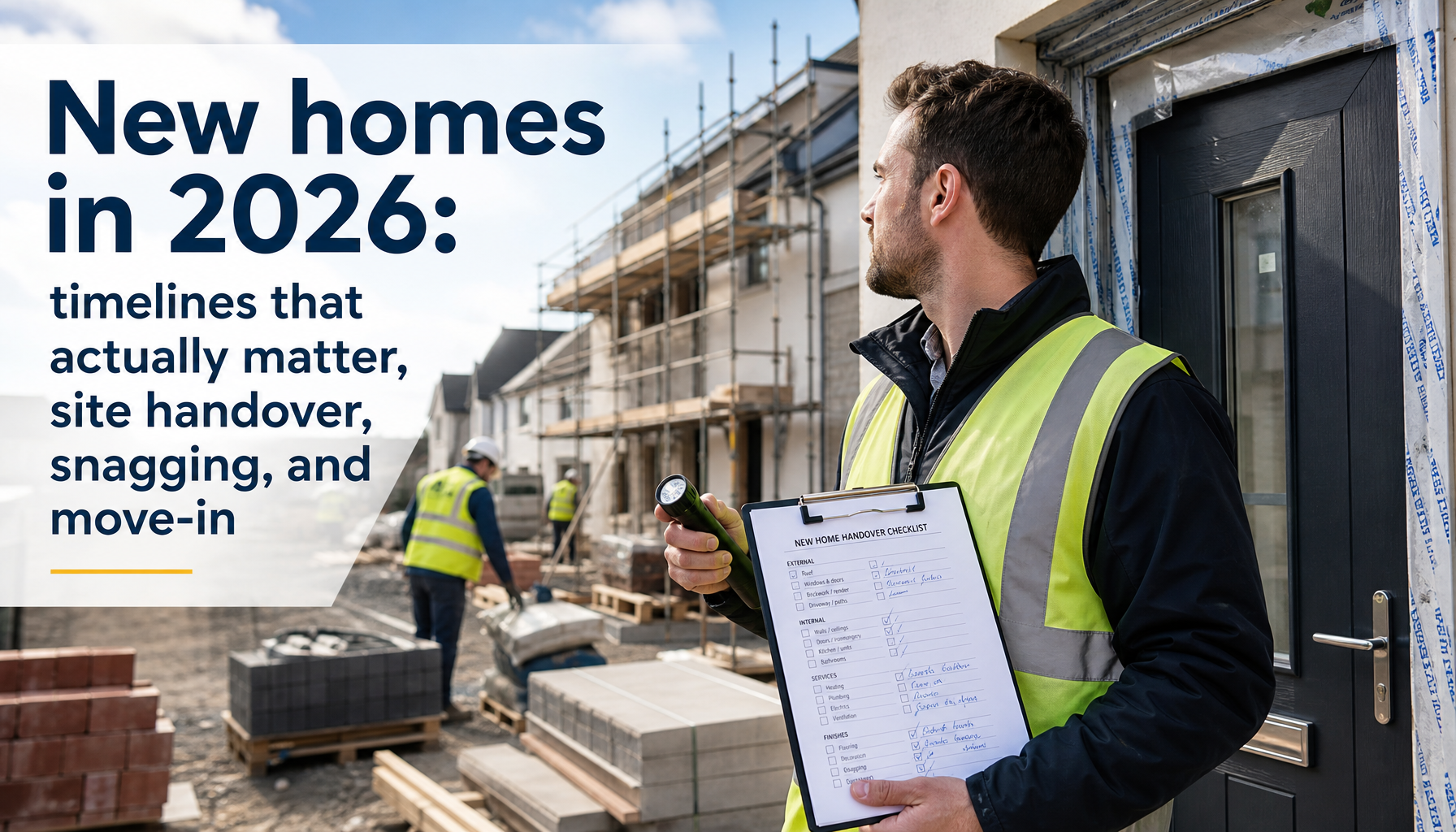
In 2026, most people buying a new home are not just shopping for finishes, they are planning a move, a school year, and sometimes the timing of selling their current home. That is why the new build timeline 2026 matters most at specific points, not simply the final “completion” date. In practice, the critical moments for many buyers are site handover, snagging, and the real-world move-in date when keys are available and systems are checked and ready.
This guide focuses on those milestones and on the questions you should be asking as your build progresses. It is not a substitute for advice from your solicitor, or for the homebuilder’s own process, but it can help you track progress in a way that reduces last-minute surprises.
1) The starting point, what “site handover” really means in 2026
When people talk about timelines, they often jump straight to snag lists and handing over keys. Yet for many developments, site handover is the first point where things become tangible. In broad terms, site handover usually marks the stage where a property or apartment development moves from early works into the period where the build is actively progressed, and where the developer’s responsibility for the specific works can become clearer.
For buyers, the practical value of understanding handover is planning. If your expected schedule depends on you having access for inspections, viewing, or readiness steps, a clear handover timeline can affect what you can realistically prepare for. It can also influence how long you may wait before you can start formal snagging processes or confirm practical readiness of the property.
What to ask at this stage (keep it simple and written down):
- When is the site handover expected for your specific phase or block? If the development is in phases, timelines can differ.
- How are you notified of changes? Ask for the communication method and frequency, for example email updates or a buyer portal.
- What are the next steps immediately after handover? Some buyers expect work to accelerate instantly, but sequencing varies.
- Is there a scheduled window for buyer inspections? Early access (if offered) can reduce later delays.
If you are buying on a plan, ask the developer to point you to where milestone dates are recorded in your paperwork. If the wording is unclear, ask your solicitor to explain what is binding and what is indicative. For broader housing context in Ireland, the Citizens Information website provides useful guidance on housing matters: https://www.citizensinformation.ie/en/housing/.
2) From handover to completion, build sequencing that affects your schedule
Between site handover and completion there is usually a sequence of trades. In 2026, buyers can lose time by assuming every home progresses at the same speed, especially in estates where multiple houses are being built simultaneously. The sequence of structure, external works, internal fit-out, and commissioning can create “bottlenecks”, where one stage stalls because another team is elsewhere or materials are delayed.
So how do you keep your expectations realistic? Track the build in terms of practical readiness, not marketing milestones. For example, you can ask whether windows and doors are installed, whether internal services are roughed in, and when finishes are due to be fitted. Those checkpoints often correlate better with when snagging can start.
Useful things to document throughout this period:
- Agreed milestones from your contract or sale documents.
- Update dates when you received written progress notes.
- Any changes in phase and what the developer says about the knock-on effect.
- Photographs if you are allowed to visit during progress.
RightPlace readers planning a sale or transition often ask how to avoid timing collisions. If you are dealing with an existing home, you may find it useful to review this guide on managing sale pressure in 2026: /news/selling-in-2026-offer-readiness-playbook-reduce-sale-fallout.
3) Snagging in 2026, the phase where time can stretch
Snagging is commonly treated as a single visit. In reality, snagging is often a process. It starts when you carry out your inspection, then it continues while the developer arranges repairs and verifies fixes. In a new build timeline 2026, this phase can be the difference between “nearly ready” and “ready to move in”.
To keep snagging from becoming a long, confusing loop, you want to approach it systematically. Your goal is to create a clear, prioritised list that helps the builder address urgent issues first. Consider separating items into categories:
- Safety and security items, such as lock functionality, ventilation where required, and any hazards.
- Weatherproofing and external integrity, for example door and window seals, drainage issues, and any signs of incomplete external finishing.
- Services and commissioning, including heating controls, hot water performance, and basic checks for appliances that are included.
- Finishes and cosmetic items, like paintwork, skirting details, and surface marks.
If the developer offers an inspection window, aim to schedule it so that you have time to compile notes and follow up. Use written evidence where possible, and avoid relying on memory. If something is repeated or cannot be tested fully at that point, note the limitation and ask when you can confirm once the system is in full operation.
For a deeper look at what buyers can negotiate near completion, RightPlace has a specific reality check that is worth reading: /news/new-build-reality-check-2026-what-to-negotiate-final-weeks-ireland.
4) Move-in date planning, keys are not the whole story
In a new build timeline 2026, the move-in date is the headline. But for practical living, it is not only about keys. Before you plan moving trucks and the handover of utilities, it is worth thinking about readiness at three levels: access, systems, and environment.
Access means you can enter safely and comfortably. Even if keys are issued, ensure that any stairwells, common areas, and temporary barriers are addressed so you can move in with minimal disruption.
Systems means that the home works as intended. You should expect to be able to test core elements, such as:
- heating operation and basic temperature control
- hot water availability
- water pressure and drainage
- electrics and emergency lighting where applicable
- ventilation and extractor performance
Environment includes external areas and immediate usability, for example landscaping status, boundary works, and whether there is ongoing finishing work that could affect daily life immediately after move-in.
A practical approach is to create your own “move-in checklist” based on what the builder says is included and what is still outstanding. If you are waiting for snag repairs, ask for a clear schedule for the completion of each category of snag item, rather than one overall statement.
5) Turning timelines into a workable plan, your buyer checklist
To make the new build timeline 2026 actionable, take these steps before the big days arrive.
- Get dates in writing for site handover, inspection opportunities, snagging windows, and the stated move-in date or possession timeline.
- Ask what happens if timelines slip. Is there a process for extensions, revised schedules, or compensation where relevant? Get the written explanation, then discuss it with your solicitor.
- Plan a contingency. Even when everything is going well, snagging can take longer than expected due to trade scheduling and materials.
- Prepare your inspection approach. Bring measuring tape if permitted, a torch, and a notebook or checklist. Photograph items clearly.
- Confirm what “complete” means. Some buyers assume the home is fully finished when completion is declared. Ask what is still to be completed after completion.
If you are also making decisions about financing, it can help to understand the moving parts of repayment structures when your move-in date influences your overall cashflow timing. For general education (not advice), RightPlace has a guide here: /news/mortgage-basics-2026-repayment-vs-term-trade-offs.
6) Common timeline traps in 2026, and how to avoid them
Even with a clear plan, buyers can get caught by predictable issues. Here are common traps and ways to reduce risk.
- Assuming one visit ends snagging. Snagging often continues after the inspection. Ask when repairs are expected to be carried out and how you will be notified once issues are addressed.
- Not prioritising urgent items. Cosmetic fixes are important, but delays can occur. Ask the developer to triage snag items by practicality and time sensitivity.
- Waiting until the last moment to check services. Where possible, confirm early that commissioning checks will be completed before your scheduled move-in date.
- Relying on informal verbal updates. Verbal reassurance is helpful, but written updates reduce misunderstandings when dates shift.
- Forgetting the “in between” tasks. Move-in is not only the keys. It includes utilities activation, insurance coordination, and access for contractors if you plan any minor adjustments (where permitted).
7) Where to find reliable housing context, beyond the estate office
Builders and sales teams can give you the specifics of your development. For broader housing information in Ireland, it can help to have an independent reference point. Citizens Information offers a central hub for topics related to housing and supports: https://www.citizensinformation.ie/en/housing/.
If you are comparing options while you wait, RightPlace can also help you browse available homes and new developments. For context on the wider market and inventory, you can start here: /new-homes.
Final thoughts, keep your new build timeline 2026 grounded in milestones
A new build timeline 2026 can look impressive on paper, but the most useful timelines are the ones that connect directly to decisions you have to make, from site handover through snagging and on to move-in. Keep your focus on the practical milestones, get the key dates and processes in writing, and treat snagging as a managed phase rather than a one-off inspection. If anything in your paperwork or communications feels unclear, speak with your solicitor before you rely on it.
With a structured approach, you can plan your move more confidently, reduce stress in the final weeks, and arrive at your move-in date with a clearer understanding of what has been completed and what is still being finished.