Best Commuter Towns Near Dublin 2026 | Prices & Commute Times | RightPlace.ie
By David S · 21 June 2026

If you've been searching for a home in Dublin and keep hitting walls — bidding wars above asking price, properties vanishing in days, budgets that stretch but never quite reach — the commuter belt starts to look very different. Not as a compromise. As a genuine choice.
The towns within 50–80km of Dublin offer something the city rarely can: space, lower prices, and in many cases, a quality of life that's hard to put a number on. The trade-off is the commute. But the commute is not always what people assume — and the price difference, town by town, varies wildly.
This guide covers the six most-searched commuter towns near Dublin for first-time buyers and families in 2026. Every price figure comes from the Property Price Register, Ireland's official record of completed sales. Commute times are from Irish Rail's published timetables and reflect typical peak-hour services. Drive times are off-peak — add 15–25 minutes for morning rush hour on the M50 and key arterials.
The Quick Reference: Commute Times & Prices at a Glance
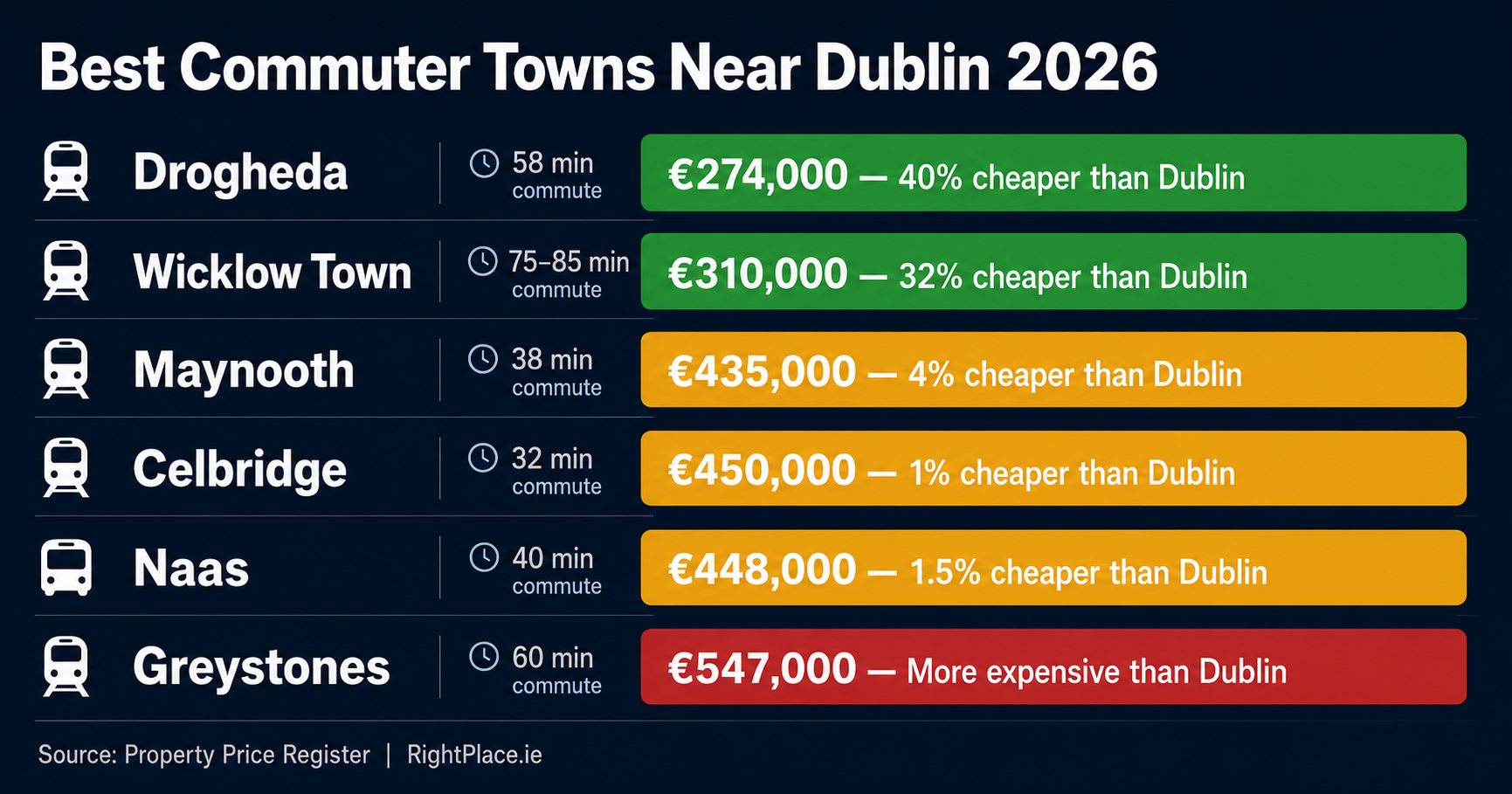
TownCountyMedian Price (2026)Saving vs. DublinTrain to CityDrive (off-peak)Train FrequencyDroghedaLouth~€274,000~40%58 min → Connolly48 min (M1)~48/day (peak every 20 min)Wicklow TownWicklow~€310,000~32%~75–85 min → Connolly65 min (N11/M11)Hourly (Rosslare line)CelbridgeKildare~€450,000~1%40 min → Heuston25 min (M4)Frequent peak (Kildare line)MaynoothKildare~€435,000~4%45 min → Connolly35 min (M4)Several/hour peakNaasKildare~€448,000~1.5%⚠️ Station 3km from town30 min (M7)Bus: 126/X126 frequentGreystonesWicklow~€480,000–€547,000❌ More expensive50 min → Connolly40 min (M11)Every ~30 min (end of line)
Dublin city median for comparison: ~€455,000 (PPR 2024–25). Drive times are off-peak — budget an extra 15–25 min at rush hour.
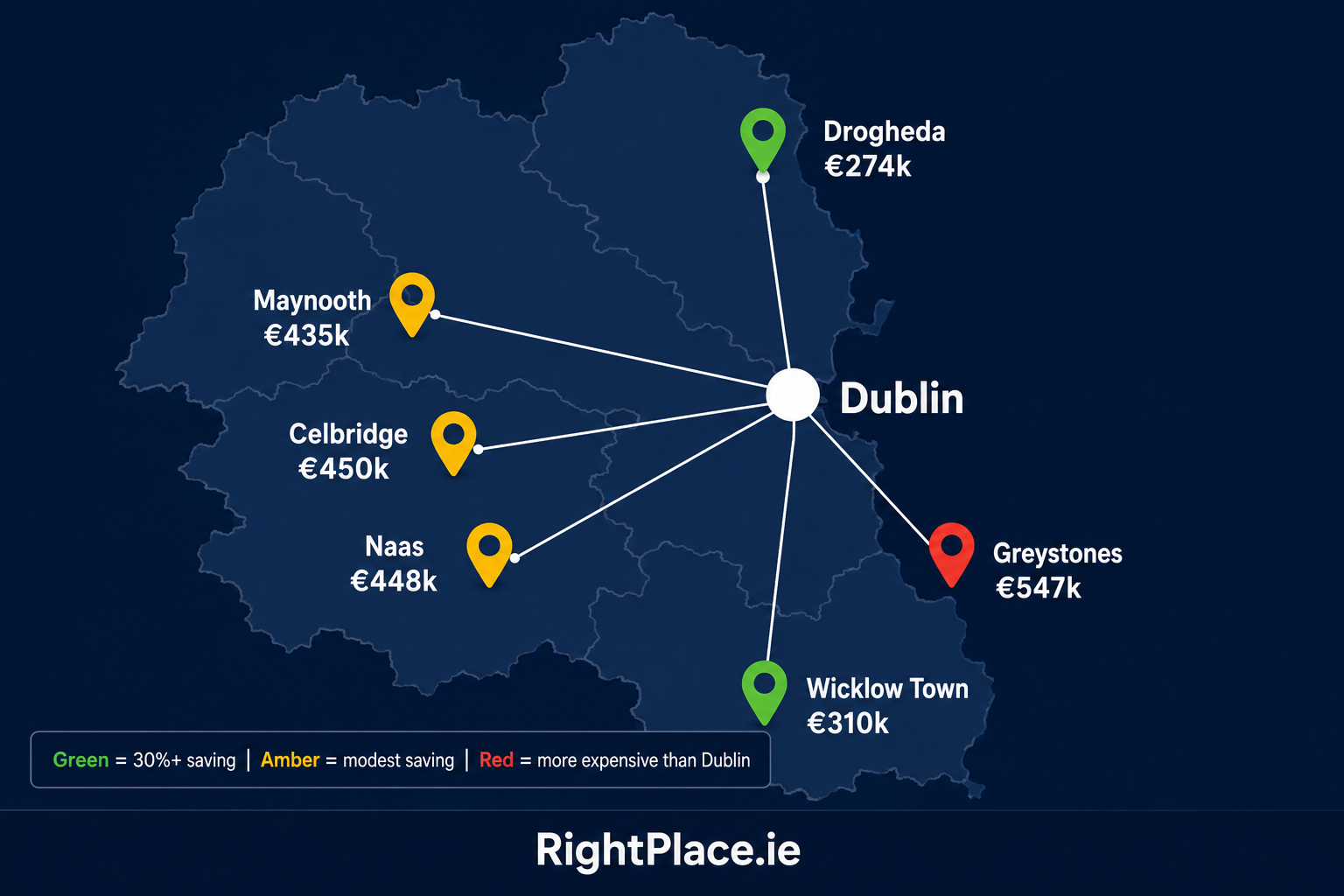
The table tells a story worth reading carefully before you decide where to search. We'll unpack each town below — but the headline finding is this: Greystones costs more than Dublin city. The DART premium has pushed prices so far that the maths no longer work as a cost-saving move. Meanwhile, Drogheda represents the single best combination of price saving, train frequency, and commute time of any town in the commuter belt.
Drogheda, Co. Louth
Best for: First-time buyers, families prioritising value, daily commuters who want rail
Median price: ~€274,000 (PPR median) | 3-bed semi average: ~€330,000
Saving vs. Dublin: ~40%
Train: 58 min to Connolly, approximately 48 services per day, peak every 20 minutes
Drive: 48 min off-peak on the M1
Drogheda is the commuter belt's most compelling value proposition, and it's not particularly close. At a PPR median of around €274,000 — with typical three-bed semis averaging €330,000 — you're looking at a 40% discount on Dublin prices for a town with real scale and infrastructure behind it.
What makes Drogheda unusual is the train frequency. For a town 48km north of the city, 48 services a day to Connolly Station is exceptional — the same frequency you'd expect from a much closer suburban stop. The commute is a genuine 58 minutes door-to-station; with the walk or bus at the other end, most people budget 70–80 minutes total.
The town itself has matured significantly. The historic Millmount area, the Boyne Valley nearby, a growing restaurant and café scene, and strong secondary schools make it a proper place to live — not just a dormitory. First-time buyers make up approximately 75% of the market here, which tells you who this town is for.
Worth knowing: Energy-efficient (A-rated) homes in Louth are achieving up to 20% more than C-rated equivalents — if you're buying here, BER rating will affect both your running costs and eventual resale.
Wicklow Town, Co. Wicklow
Best for: Buyers who want coastal living at a genuine discount; hybrid workers (2–3 days in Dublin)
Average price: ~€310,000 (3-bed semi)
Saving vs. Dublin: ~32%
Train: ~75–85 min to Connolly (Rosslare Europort line), hourly frequency
Drive: 65 min off-peak on the N11/M11
Wicklow Town is the forgotten option in most commuter belt conversations — which is partly why it still offers real value. While the northern Wicklow towns of Bray and Greystones have been priced up to or beyond Dublin levels, Wicklow Town itself — 60km south of the city — is averaging around €310,000 for a three-bed semi. That's a meaningful saving.
The catch is the commute. Train frequency on the Rosslare Europort line is roughly hourly rather than the near-continuous service on the DART or Kildare commuter line. The journey to Connolly runs 75–85 minutes. Driving the N11/M11 corridor takes around 65 minutes off-peak — longer in morning traffic, where the N11 bottleneck at Bray adds time.
What Wicklow Town offers in return is a genuine coastal town with a real identity: a working harbour, Wicklow Head lighthouse, a compact and functional town centre, good primary and secondary schools, and the Wicklow Mountains on the doorstep. Northern Wicklow's rental market is under severe structural pressure from Dublin commuter demand — but Wicklow Town's relative distance has kept it somewhat insulated.
Verdict: Best suited to people working hybrid schedules who want coastal space at a price Dublin can't match. Daily commuters should model the actual journey time carefully before committing.
Maynooth, Co. Kildare
Best for: Professionals who want Western Commuter rail access; families; buyers with budgets around €400,000–€500,000
Average price: ~€435,000–€480,000
Saving vs. Dublin: ~4–5%
Train: 45 min to Connolly, several services per hour at peak
Drive: 35 min off-peak on the M4
Maynooth sits at the northern end of Kildare's commuter belt and benefits from excellent train access — the Western Commuter line into Connolly is frequent and reliable. The town has grown substantially around Maynooth University, which gives it a younger demographic, a good café and restaurant scene, and a lively calendar of events that larger commuter towns often lack.
The challenge: prices have risen sharply. At €435,000–€480,000, Maynooth now saves you only around 4–5% on Dublin city prices. That's a modest discount for a 45-minute commute on days when you're in the office.
That said, what you get for the money is genuinely different from Dublin. Three-bed semis with gardens, quieter streets, and the Kildare countryside around you. The M4 makes it accessible by car as well, and Maynooth's position — between Dublin and Athlone — means it's well-served by national road and bus networks too.
Worth knowing: Maynooth University generates strong rental demand, which keeps vacancy low and supports long-term price growth — useful context for buyers thinking about resale value.
Naas, Co. Kildare
Best for: Buyers who drive rather than commute by train; families who want a large, fully-serviced town
Average price: ~€448,000–€475,000
Saving vs. Dublin: ~1.5–5%
Train: ⚠️ Naas station (Sallins & Naas) is 3km from the town centre — car or bus required
Drive: 30 min off-peak on the M7
Naas is Kildare's county town — well-resourced, well-located, and substantially bigger than most commuter belt options. It has everything you'd expect: major retail, a strong school network, the Curragh racecourse nearby, good sporting and leisure facilities. For families who work in Dublin but spend most of their time in Kildare, it's a very functional place to be based.
The price story, however, has changed. At €448,000–€475,000, Naas is now almost indistinguishable from Dublin city in cost terms. Prices rose nearly 12% in 2025 alone, driven by Dublin buyers moving out. The window for a meaningful discount has largely closed.
The train situation deserves specific mention. Naas doesn't have a town-centre station — Sallins & Naas is 3km from the main street. If you're planning to commute by train, you'll need a car or a bus connection to the station first. The 126/X126 bus route to Dublin is a strong alternative for many commuters, running frequently at peak hours along the M7.
Verdict: Excellent town for quality of life; poor value as a cost-saving alternative to Dublin given current prices.
Celbridge, Co. Kildare
Best for: Buyers who want to be genuinely close to Dublin without city prices; M4/M7 corridor workers
Average price: ~€450,000–€480,000
Saving vs. Dublin: ~1%
Train: Hazelhatch & Celbridge station on the Kildare commuter line, ~40 min to Heuston
Drive: 25 min off-peak (M4)
Celbridge is the closest town on this list to Dublin — just 25km from the city centre on the M4 — and that proximity has pushed prices up accordingly. At €450,000–€480,000, the saving over Dublin is essentially negligible. What you're buying is space and a different lifestyle rather than a financial discount.
Celbridge itself has a pleasant character: the Liffey Valley, Castletown House (one of Ireland's great Palladian houses, open to visitors), and a town centre that has expanded significantly with new estates over the past decade. The Kildare commuter line serves Hazelhatch & Celbridge station with connections to Heuston in approximately 40 minutes — but the station is not central, so factor in access.
Verdict: Fine choice if proximity to Dublin is your primary concern, but don't move to Celbridge expecting a property bargain. The value play in this corridor is Newbridge (further down the Kildare line) or, further again, Portlaoise.
Greystones, Co. Wicklow
Best for: People who want DART access and coastal living and aren't driven primarily by price
Average price: ~€480,000–€547,000
Saving vs. Dublin: ❌ None — it costs more
Train: 50 min to Connolly (DART), services every ~30 minutes (end of line)
Drive: 40 min off-peak on the M11
This needs to be said plainly: Greystones is more expensive than Dublin city. The DART end-of-line premium, combined with genuine lifestyle demand for the coastal setting, has pushed median prices to around €480,000–€547,000. The Dublin city median by comparison is approximately €455,000. If you're moving to Greystones expecting to save money relative to Dublin, you'll be disappointed.
That framing isn't the whole story, though. What Greystones sells is a way of life: the harbour, the cliff walk to Bray, a walkable town centre with a strong independent food and retail scene, Burnaby Park, multiple good schools, and a genuinely tight-knit community. The DART is frequent and scenic. People who move to Greystones typically do so because they want to live there — not because they're making a financial calculation.
If you're a buyer weighing this up, the honest question is: would you pay a premium above Dublin prices to live somewhere genuinely beautiful with excellent schools and coastal walks? Some people would, and do. If you want a discount on Dublin, Greystones is the wrong direction.
How to Choose the Right Commuter Town
If you need to commute daily by train: Drogheda is the clear winner — 40% cheaper than Dublin, 48 train services a day, 58 minutes to Connolly. Maynooth works well too if you prefer the M4 corridor and can accept minimal savings.
If you work hybrid (2–3 days in office): Wicklow Town and the further Kildare towns (Newbridge, Portlaoise) open up. The commute is manageable a few days a week, and the price savings are significant.
If you're driving: Naas and Celbridge are closest on the road, but the M7 and M4 in rush hour add real time. Model your actual commute at 8am, not on a Saturday afternoon.
If schools are the deciding factor: Drogheda, Maynooth, and Greystones all have well-regarded secondary schools. Research specific catchment areas before buying — school availability isn't automatic at secondary level.
If you want coastal: It's Greystones (premium), Bray (slightly less so), or Wicklow Town (genuinely affordable). Each offers a very different style of coastal living.
If you're still deciding between staying in Dublin or moving out, our guide to the best places to live in Dublin covers what the city itself offers at different price points — useful context before you commit to a commute. And for a broader look at what lies beyond the ring road, see our Beyond the M50 guide which covers the wider Leinster commuter belt.
The Bottom Line on Commuter Belt Prices
The commuter belt is not the uniform bargain it once was. Celbridge and Naas are now within rounding error of Dublin city prices. Greystones actually costs more. The meaningful savings are concentrated in two places: Drogheda, which remains the strongest value proposition in the commuter belt at ~40% below Dublin, and Wicklow Town, which offers coastal affordability that north Wicklow long since lost.
Everything else is a lifestyle trade-off rather than a financial one — more space, slower pace, different schools — at prices that are now only modestly cheaper than the city you're leaving.
All property price data from the Property Price Register and Real Estate Alliance surveys, reflecting 2025–2026 completed sales. Train times from Irish Rail published timetables. Drive times are off-peak estimates. Search properties in all commuter towns at RightPlace.ie.